A group of children seated on the floor raise their hands during an event.
Children and families gathered at the 10th anniversary celebration for the Kindergarten to College program in San Francisco.
Photo: City and County of San Francisco
A woman places mortarboard on child’s head, surrounded by other children.
Mayor London Breed places a graduation cap on a first grader at the 10th anniversary celebration for the Kindergarten to College program in San Francisco.
Photo: City and County of San Francisco

Highlights


Mott grantees helped move children’s savings accounts from a visionary idea to a tangible strategy that has raised the educational aspirations and opportunities of millions of children and families.


Spanning nearly three decades, Mott’s early support for pilot projects, research, demonstrations and evaluations helped establish proof of concept, provide effective models for the CSA field and inspire a national policy.


Supported, in part, by Mott, San Francisco’s Kindergarten to College initiative launched in 2011, becoming the nation’s first universal, automatic CSA program.


Mott leadership and early support for CSA exemplars, champions and strategic communications helped raise the visibility of CSAs and inspire replications around the country. By the end of 2025, an estimated 7.7 million children had a CSA in their name. There are more than 120 CSA programs in 41 states and the District of Columbia.


With Mott support, research leaders such as Michael Sherraden at the Center for Social Development at Washington University in St. Louis and William Elliott III, earlier at the University of Kansas, now at the University of Michigan, led groundbreaking research that has been instrumental in the growth of well-designed CSA programs and advancing the overall field.


Mott helped found the Asset Funders Network, whose members helped educate grantmakers about CSAs and their benefits.


Mott grantees helped integrate CSAs with broader college affordability initiatives, college access and financial aid reform efforts, and social services that address low-income families’ holistic needs.


Mott grantees guided the evolution of CSA practices, paving the way for the next generation of children’s savings programs.

In cap and gown, the first class of kindergarteners in the country to receive CSAs have begun to graduate high school and pursue their post-secondary dreams. Back in 2011, their families took part in a pioneering program, Kindergarten to College in San Francisco, that automatically opened a savings account, seeded with $50, to help them put their children on a path to post-secondary education.

These students’ graduation was a watershed moment for the CSA field, which has steadily worked to help low- and moderate-income families access CSAs to build a brighter future for their kids.

Yadira Vazquez, class of 2023, was a kindergartener when the county of San Francisco automatically opened a savings account for every child entering public school. Taking part in the savings program meant “hope for me that I’m able to go to college,” Vasquez said, “and I’m very proud of that.”

Young woman with red hair poses in her high school graduation cap and gown.
Yadira Vazquez took part in the savings program, Kindergarten to College, in San Francisco as a kindergartener. Photo: City and County of San Francisco

Thirty years ago, few people had heard of CSAs. By the end of 2025, an estimated 7.7 million children had a CSA in their name. There are more than 120 CSA programs in 41 states and the District of Columbia, administered by an array of nonprofits, state and municipal agencies, educational institutions and credit unions — and a new national program. Combined with seed deposits, savings incentives and other supports, these programs have helped children and their families envision post-secondary possibilities — and take practical steps to bring them into reality. Mott’s grantees have been at the forefront of the growth and development of the CSA field since its inception. Over the past three decades, the Foundation has provided more than $38 million in grants that help move CSAs from a bright idea to a tangible policy and programmatic strategy that benefits millions of children and their families.

Two young girls hold dollar bills they will use to open a savings account.
Kids participating in an event for the K2C program in San Francisco. Photo: City and County of San Francisco

Beyond fostering the growth of CSAs, our grantees have helped the field understand what works — studying program design and implementation so CSAs reach families of all backgrounds, engage communities and deliver real results. That depth of experience offers valuable insight as the nation launches a new pilot to seed accounts for newborns across the country.

Mott’s focus on educational savings, first embedded in the Foundation’s Pathways to Opportunity plan, and more recently in our Education program, was fitting. Charles Stewart Mott believed that the surest pathway out of poverty is a solid education and that “economic education” — today financial literacy — is an essential part of it. CSAs bring these two ideas together, offering a modern expression of values that have guided the Foundation’s work for nearly a century.

The Foundation became an early champion of the CSA field and has stayed with this work since the early 2000s because the results are undeniable. Even small savings can spark big change: Children from low- and moderate-income families with a CSA are three times more likely to enroll in college and four times more likely to graduate than peers with no savings. More than money alone, CSAs help families imagine a wider horizon — raising parents’ expectations and strengthening children’s sense of what’s possible.

The Mott Foundation has long believed early investments in families can have significant and positive payoffs for children, communities and the country as a whole. We now have research confirming that CSAs are an effective way to help young people achieve a brighter future.”
A black and white headshot of Ridgway White. Ridgway White, Mott Foundation president and CEO
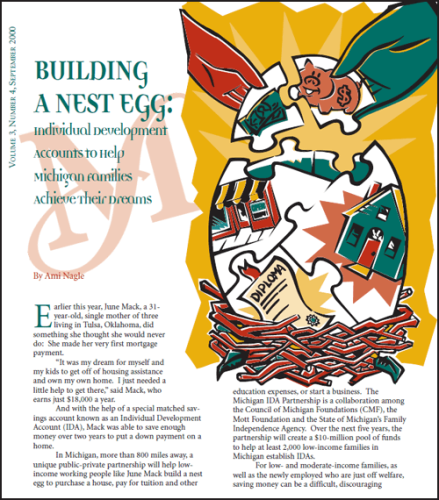
Cover of a Foundation publication with an article titled “Building a Nest Egg: Individual Development Accounts to Help Michigan Families Achieve Their Dreams”
The cover of a Mott Foundation publication shows an article from 2000 exploring the impact of matched savings Individual Development Accounts in Michigan.

A catalyzing idea: Savings are ‘hope in concrete form’

The concept of children’s savings accounts in the U.S. emerged in the early 1990s. In his 1991 book “Assets and the Poor,” Michael Sherraden argued that poverty is not only a lack of income — it’s a lack of assets. When families have the opportunity to build assets, he wrote, the benefits extend far beyond financial security. They strengthen household stability, the ability to plan for and shape one’s future, and a sense of possibility that can last a lifetime.

Those insights set the asset-building field and the Mott Foundation on a journey toward children’s savings. In the 1990s, Mott supported studies of individual development accounts, matched savings tools that help families to save for goals like homeownership, post-secondary education or a small business startup. These programs also included an important safeguard: The savings didn’t count against benefits such as TANF, Food Stamps or Medicaid. The results showed that families could and did save when given the opportunity, and parents quickly expressed a desire for their children to have accounts of their own.

From there, the work turned to exploring the full potential of children’s savings. The challenge was clear: taking a catalytic idea and turning it into something real and meaningful for children and families.

Seeding the children’s savings field

In the nascent years of the CSA field, Mott supported rigorous, pioneering research that examined not only how CSAs helped families save, but how the simple fact of having an account could shift parents’ and children’s expectations and planning.

Early grantmaking supported the Center for Social Development at Washington University in St. Louis and the University of Kansas, where foundational research began to uncover the “multiplier effect” of children’s savings: Even modest assets were linked with stronger educational aspirations, greater engagement in planning for the future and, over time, improved academic outcomes.

Mott helped fund Saving for Education, Entrepreneurship, and Downpayment, a multiyear initiative begun in 2003 that piloted asset-building accounts for children and youth in 12 states and communities. Working with more than 1,200 children and families, SEED generated some of the first large-scale evidence that CSAs could be implemented widely and deliver meaningful benefits — from increased saving to stronger parental involvement, college-going expectations and youth development.


To deepen the evidence, Mott and other funders supported the Center for Social Development in launching SEED for Oklahoma Kids in 2007. SEED OK remains one of the most significant tests of CSAs in the U.S. The study found that infants who received an Oklahoma 529 account experienced lasting educational and developmental benefits: Families were more college-focused, saved more consistently, and held higher expectations for their children’s futures than similar families without a CSA. These trusted findings — still generating insights today — strengthened the case for universal, automatic, statewide programs.

Mott also supported Prosperity Now, which played a pivotal role as a national intermediary — translating emerging research into practice, building networks, producing policy briefs and creating the first national survey to track the growth of CSA programs. Washington University also expanded the knowledge base by examining the broader benefits of asset-building strategies for families with low- and moderate-incomes and helping operationalize CSA concepts in real-world settings.

Together, this body of work gave state leaders and community champions the confidence to advance CSA initiatives of their own.

City and state exemplars propel the field forward

Maine was an early leader. There, the Harold Alfond College Challenge Program, created by the nonprofit Alfond Scholarship Foundation, launched the nation’s first statewide CSA program. Started in 2008 as a pilot program in Portland, the college challenge program now automatically awards a $500 grant to every child born in the state. Mott’s support has helped the Alfond challenge program evaluate results and inspire children’s savings accounts efforts in the New England region and other states.

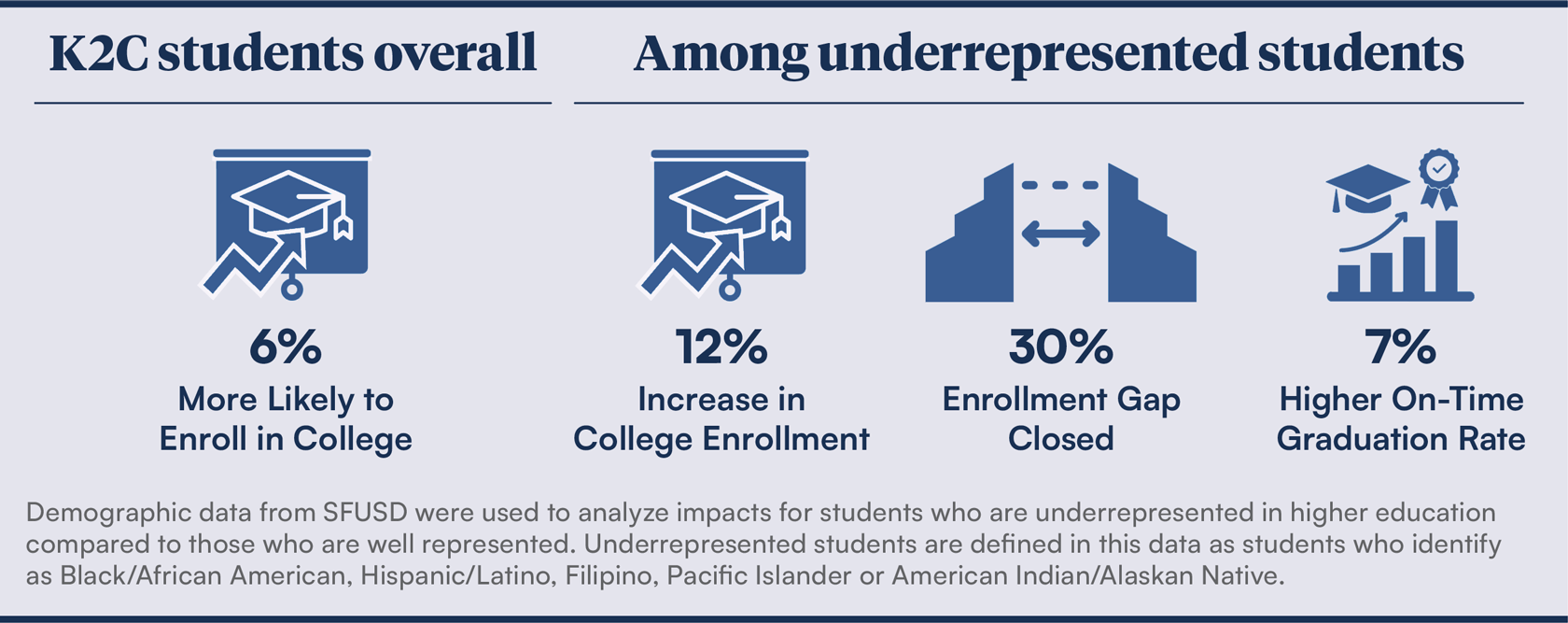
With the founding of Kindergarten to College in 2010 by then Mayor Gavin Newsom (now governor) and Treasurer José Cisneros, San Francisco became the first city in the country to create a universal, automatic CSA program. Research on the program, led by William Elliott III at the University of Michigan, found that CSAs increased on-time high school graduation and post-secondary enrollment, especially for underrepresented youth. From K2C’s design phase in 2010 through its implementation and operation over the next 15 years, the Mott Foundation provided more than $3.3 million in support that helped the program take root and grow.

Elected officials sit in front of an audience of children at an event
(From left to right) State Treasurer Fiona Ma, California Gov. Gavin Newsom, San Francisco Mayor London Breed, and City and County Treasurer José Cisneros joined first graders to celebrate K2C’s 10th anniversary. Photo: City and County of San Francisco

The successes of both programs helped galvanize interest in expanding CSAs, including in California where, as governor, Gavin Newsom established CALKIDS. The program, which also is supported by Mott, quickly became one of the nation’s largest statewide savings initiatives and now provides accounts for millions of California children.

Graphic showing the results of a long-term study on the Kindergarten to College program in San Francisco.
Image: Courtesy of K2C

Momentum: CSAs in every part of the country

Drawing inspiration from these and other exemplars, from 2012 to 2024, dozens of new communities and states adopted their own CSA strategies.

School-community-government partnerships — the backbone for successful efforts — paved the way for CSA initiatives in Oakland, California, Boston, Massachusetts and other cities. Illinois, Nebraska and Pennsylvania enacted automatic college savings accounts with seed deposits for every child born or adopted in the state. Nevada launched savings accounts for all kindergarten children in public school. Mayors, such as Melvin Carter in Saint Paul, launched the nation’s first city-led CSA programs to start at birth.

A chart showing the total number of CSA programs in operation, with a total of 23 in 2021.
Image: Courtesy of Prosperity Now

Mott continues to help the field bring CSA successes to scale. In the Midwest, for example, support from Mott has helped the city of St. Paul to lead the Midwest CSA Consortium, which has spurred regional growth by providing technical assistance, facilitating peer learning and building strong cross-state networks. First launched in 2017 in the upper Midwest, it has since grown to include nine states: Minnesota, Wisconsin, Illinois, Missouri, Nebraska, Iowa, Indiana, Ohio and Michigan. Inspired by the New England CSA collaborative, the consortium has expanded access to CSAs for thousands of children and strengthened programs that support families’ long-term educational goals.

Given the crucial role that state and city leaders have played in launching CSAs, the Foundation also is helping grantees, such as the National League of Cities Institute and National Association of State Treasurers, provide education, networking and technical assistance.

Future ready: The next generation of CSAs

Along with fostering the growth of programs, Mott’s grantees are working to ensure CSAs reach, and work for, the families and children who need them most.

They are helping connect CSAs with broader strategies that make college more attainable by linking programs with college affordability initiatives, financial aid reform efforts and social services that address families’ holistic needs. Grounded in lessons from more than 120 programs in cities and states around the country, they continue to advance research and development that guides the next generation of CSAs and sharpens our understanding of what drives the strongest results for kids.

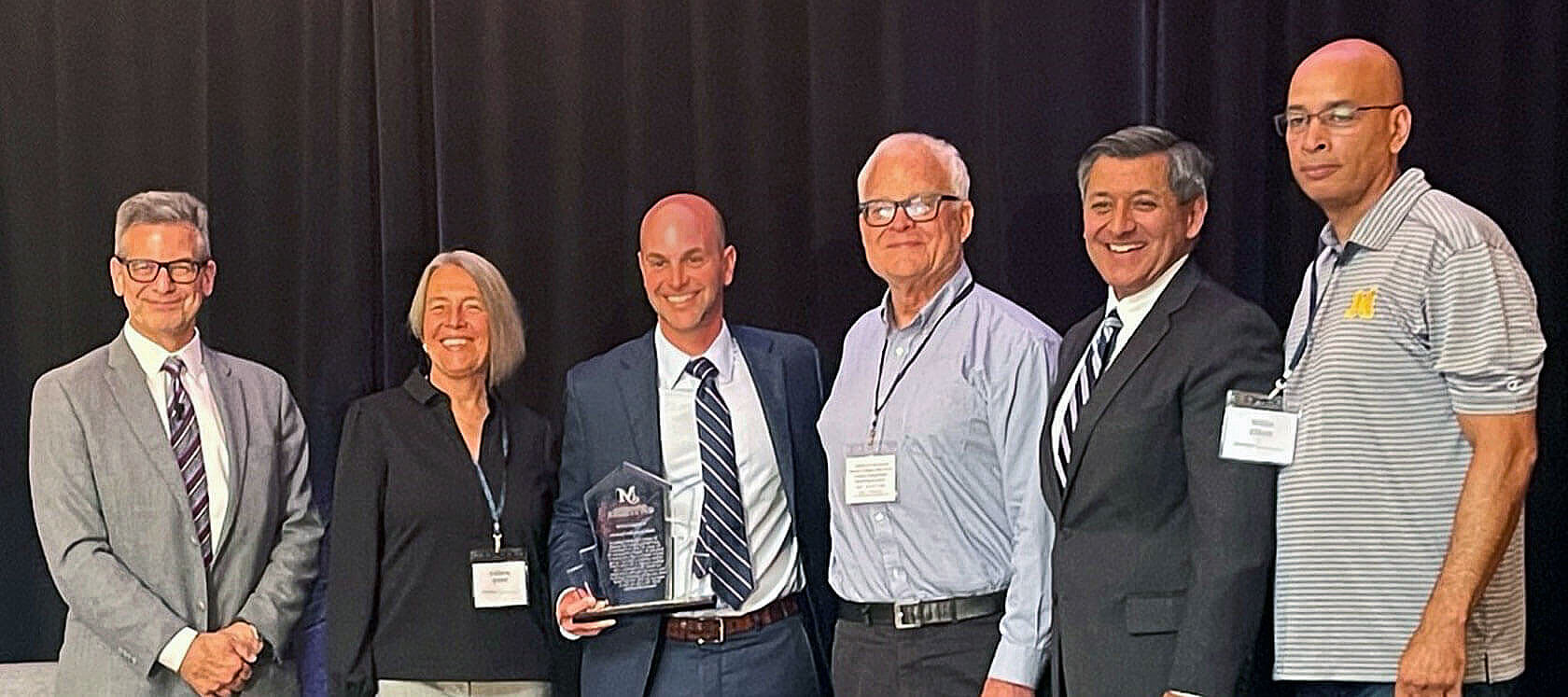
CSA experts pose for a group photo with an award for the Mott Foundation president
Ridgway White (third from left) accepted an award from longtime CSA leaders (from left to right), Ray Boshara (Washington University), Colleen Quint (Alfond Scholarship Foundation), Michael Sherraden (Washington University), José Cisneros (city and county of San Francisco) and William Elliott, III (University of Michigan). The Mott Foundation was recognized for consistent funding that demonstrated the impacts of children’s savings accounts and expanded the field to serve millions of children. Photo: Courtesy of University of Michigan

The emergence of Trump Accounts marks a new chapter in the growth of children’s savings. The federal initiative will invest $1,000 for every child born in the U.S. between 2025 and 2028 and create new avenues for savings growth and financial education. As the first effort to offer children’s savings on a nationwide scale, it could help a new generation of young people see themselves as savers, investors and future college students. Mott’s grantees bring a depth of insight to this next phase that can inform the rollout and support efforts to realize the initiative’s full potential for children and families.

They also continue to innovate the core idea. When children in every community have a savings account in their name — earmarked for college and paired with financial literacy — they are better prepared to imagine, navigate and shape their future.