A young boy runs excitedly toward a man, who waits for him with a smile. They are in a gymnasium, and others play in the background.
Children and adults enjoy fun and learning at the International Academy of Flint, thanks to programming led and coordinated by the Flint Center for Educational Excellence. The Center’s six initiatives include community education, and comprise an integrated, full-service approach to helping local children, their families and the community to flourish.
Photo: Jenifer Veloso
A black-and-white photo of a man helping a young girl to put on roller skates circa 1970.
A community school director in Flint helps a youngster to put on roller skates circa 1970. Recreational activities for residents of all ages were part of the city’s “lighted schoolhouse” approach to community education.
Photo: Charles Stewart Mott Foundation archives

Highlights


In 1935, the Mott Foundation launched a school-based recreation program serving children in Flint, Michigan.


As the model evolved to include a wide range of activities and services for residents of every age, the schools became hubs of community life.


Flint’s approach to the “lighted schoolhouse” soon captured attention far beyond the city. With Mott support, it eventually traveled to more than 140 countries across six continents.


The onset of long-term economic struggles in Flint in the 1970s fueled a dramatic decline in the city’s community education programs.


As part of a citywide master planning process that began in 2012, Flint residents called for a fresh, modern approach to community schools. Mott responded by supporting a pilot program at two Flint schools in 2014.


To help address local needs sparked by the city’s water crisis, the Foundation moved quickly to expand the initiative throughout the Flint district and to several other local schools.


Today, the Mott-funded Flint Center for Educational Excellence leads an exciting, full-service approach to community education in and around the city.

The launch in the 1930s of a youth recreation program in our hometown of Flint, Michigan, provides an early example of how the Mott Foundation’s grantmaking has helped to identify, develop and share promising approaches to issues that people and communities face.

Begun as a small pilot project, the school-based initiative soon expanded across the city, offering educational, enrichment, health and other programs to all Flint residents. As a result of its unique design, it also began to change the ways in which people engaged with their schools and each other.

The success of the Flint model ushered in an exciting new era in public education in the U.S. and, ultimately, around the world.

Birth of community schools in Flint

While attending a Rotary Club meeting in Flint in June 1935, Charles Stewart Mott heard a presentation by local educator Frank Manley about the importance of helping the city’s children to stay safe, active and engaged during out-of-school hours.

Manley’s solution: Keep the doors of Flint’s public schools open after the last bell rings and provide young people with high-quality recreational programming.

In this edited excerpt from a 1969 interview with Flint-area television station WJRT ABC 12, C.S. Mott reflected on Frank Manley’s idea and its evolution into a community schools approach to public education.

In addition to recreational activities for young people, the initiative soon offered academic, physical fitness and personal development opportunities to residents of every age. Local agencies began providing medical and social services at the schools, which also hosted neighborhood gatherings and events.

As the city’s schools became hubs of community life, their relationship with those they served began to change. Residents joined neighborhood advisory councils and worked with principals, teachers and community partners to identify local needs and interests, and to develop related programming. Many became adult education instructors, sharing their unique skills, talents and experiences with their neighbors.

The schools also engaged residents outside the traditional classroom setting. A visiting teachers initiative brought services and resources directly to local homes, while a collaboration with area correctional facilities made counseling, adult education and job training opportunities available to community members involved in the justice system.

A teacher and students at Flint’s Fairview Elementary School circa 1940s. Having operated as a community center since the Great Depression, the school — with Mott support — expanded its roster of health, social service and educational programs in 1947. This helped to establish a model for Flint’s full-service community schools.
Photo: Charles Stewart Mott Foundation archives
A black-and-white photo of a woman learning how to reupholster a chair circa 1950s.
A Flint resident hones her skills in reupholstering furniture circa 1950s. The city’s adult education programming reflected the needs and interests identified by the community.
Photo: Courtesy of Sloan Museum
A black-and-white photo of two men watching an instructor use a metal lathe circa 1960.
An adult education instructor in Flint demonstrates how to machine metal using a lathe circa 1960. Mott-funded community education included courses designed to help residents prepare for and obtain jobs.
Photo: Charles Stewart Mott Foundation archives
A black-and-white photo of a group of young women listening to a presentation circa 1950.
Young women participate in Stepping Stones circa 1950. With support from Mott’s community education grantmaking, the school-based club fostered the personal development of Flint-area girls ages 10 to 18. Stepping Stones continued to operate until 1980.
Photo: Charles Stewart Mott Foundation archives
A black-and-white photo of a man looking at a school bulletin board featuring a schedule of educational activities circa 1960s.
A community school director surveys the schedule of community education courses and activities at Flint’s Potter Elementary School circa 1960s.
Photo: Charles Stewart Mott Foundation archives
A black-and-white photo of a group of women learning to use typewriters circa 1978.
Flint residents participate in a typing course offered through Mott-funded adult education programming circa 1978.
Photo: Charles Stewart Mott Foundation archives

Community schools over the years

1/6

Hometown success ignites global interest

The economic boom in the U.S. after World War II fueled a spike in Flint’s population, with many new arrivals finding employment in the city’s then-thriving automotive industry. As the number of residents continued to swell, the Mott Foundation worked with the Flint school district to expand the community schools program, including its adult education component, to meet changing needs.

Recognizing the model’s increasing complexity, the Foundation introduced the role of the community school director in 1951.

Equipped with a professional background in education and specialized training in the Flint approach, community school directors managed all aspects of the model at their assigned schools. They organized youth programs, coordinated and taught adult education classes, and recruited and mentored volunteer instructors. They also worked with neighborhood representatives to identify residents’ needs and interests, with school staff to address potential concerns, and with area partners to fill gaps in health and social services.

And throughout their duties, they helped to cultivate positive relationships between — and within — the schools and the community.

A black-and-white photo of a group of men gathered around a table for a meeting about community education.

Sharing the lighted schoolhouse model

C.S. Mott believed that, in order to spread the Flint model of community education, we needed to invite the world to see it in action in our hometown.

Educators from Mexico City met with Frank Manley (standing, third from left) in Flint in 1966 to explore ways they might bring the lighted schoolhouse approach to their own communities.

Photo: Charles Stewart Mott Foundation archives

This recipe of standardizing core structures and processes while tailoring a wide array of programs and services to the neighborhoods being served set the Flint approach apart from other community school models in the U.S.

By 1957, the city became a destination for people from across the country and around the world seeking to replicate Flint’s approach to the “lighted schoolhouse” in their own communities. As the number of annual visitors grew to more than 12,000 by the mid-1960s, competition mounted for the limited pool of trained and experienced community school directors who could help lead the new programs.

In response, the Foundation in 1964 launched the Inter-University Clinical Preparation Program for Educational Leadership — or the Mott Intern Program, as it came to be known. It offered an intensive, one-year curriculum that included graduate-level coursework in community education, as well as rotating internships with Flint Community Schools and public and private institutions throughout Michigan.

A total of 667 participants completed the Flint-based program, which operated through a partnership with seven public universities in Michigan from 1964 to 1974.

Graduate-level training in the U.S. continued through 1982 via a Mott-supported national network of university-linked programs. That same network also prepared non-degree students — more than 2,000 each year, as of 1975 — to serve as community school directors.

The rising tide of public demand for community schools programming in the U.S. — sparked, in part, by the Flint model — helped lead to passage of the federal Community Schools Act of 1974, which provided funding for related research, training and program development at the state and local levels.

As school districts around the country explored and increasingly adopted new philosophies and approaches to community education, the Mott Foundation expanded our national grantmaking for community schools to include support for studies on the role and value of community education in a lifelong learning continuum. Through 2006, we also helped to fund technical assistance for school districts in the U.S. seeking to start or improve local community education programs.

With interest in the Flint model flourishing outside the U.S., the Foundation helped to launch an international community education center — the first of its kind — in LaPaz, Bolivia, in 1975. This was soon followed with support for community education development and training initiatives in Canada, the Caribbean and United Kingdom, and for international programs and conferences in Australia and Central and South America.

In time, the Mott Foundation’s support for community schools — which continued on the international front through 2021 — helped the Flint approach travel to more than 140 countries across six continents.

Community schools come full circle in Flint

Reflecting, in part, the unique partnership — and significant number of personnel — involved in the development, implementation and, ultimately, dissemination of the Flint model, most Foundation staff between 1935 and 1969 were employees of the Flint Board of Education. In addition, our grant support for various local organizations and initiatives was administered through the school district.

Following the passage of the federal Tax Reform Act of 1969, we separated our staff from the Flint Board and began plans for managing our grant support in house. With our grantmaking at home and around the world continuing to expand and evolve, we also recognized the need to help the school district prepare to take ownership of — and financial responsibility for — the city’s community education programming.

To those ends, in 1977 we began a decade-long process of phasing out our broad funding to the school district.

That necessary action was soon complicated by painful changes in Flint’s fortunes, with downturns in the domestic auto industry and subsequent plant closures leading to substantial job losses. This dealt a devastating blow to the community, which, like many urban centers across the U.S., already was struggling with a dwindling tax base — and, as a result, less funding for local schools — as residents moved elsewhere.

As Flint Community Schools grappled with the harsh new economic reality, community education as a district priority began to decline, along with the quality and scope of the local programming. Residents’ participation continued to wane, and, by the mid-1990s, an important chapter in the Flint model’s story had come to a close.

As we strived to help our hometown navigate its way forward in what became a persistent economic storm, we also remained open to helping launch a new era of community education in Flint.

As part of a citywide master planning process that began in 2012, Flint residents called for a fresh approach to community schools, reimagined for the 21st century, as a top priority. The Mott Foundation responded, supporting a pilot program at two Flint schools in 2014. To help deal with the effects of the Flint water crisis, we provided funding that quickly expanded the model — first to five and then to all 11 schools that were part of the Flint Community Schools district at the time, as well as several other schools in and around the city.

Today, the Community Education initiative is led and coordinated by the Flint Center for Educational Excellence. Launched with Mott support in 2023, the center also is home to the Flint Early Childhood Collaborative, Network for School Excellence, Community Council on Education, Flint Parent Collaborative and Thrive Afterschool. The six programs comprise an integrated, full-service approach to helping local children, their families and the community to flourish.

At the forefront of that strategy is promoting student success in and beyond the classroom. For example, the Flint Center for Educational Excellence works with schools to provide high-quality learning and development opportunities via early childhood and afterschool programs, along with college- and career-readiness curricula. Parents and caregivers are actively encouraged to participate in their child’s success, while student advisory councils engage youth in developing programming that reflects their unique needs, interests and aspirations.

In recognition of the vital role that strong families and neighborhoods play in creating a culture of education, hope and inspiration, the schools and other local partners offer a range of adult education and workforce training opportunities. To further fuel positive impact, community partners provide access to health services, life skills training and recreational opportunities.

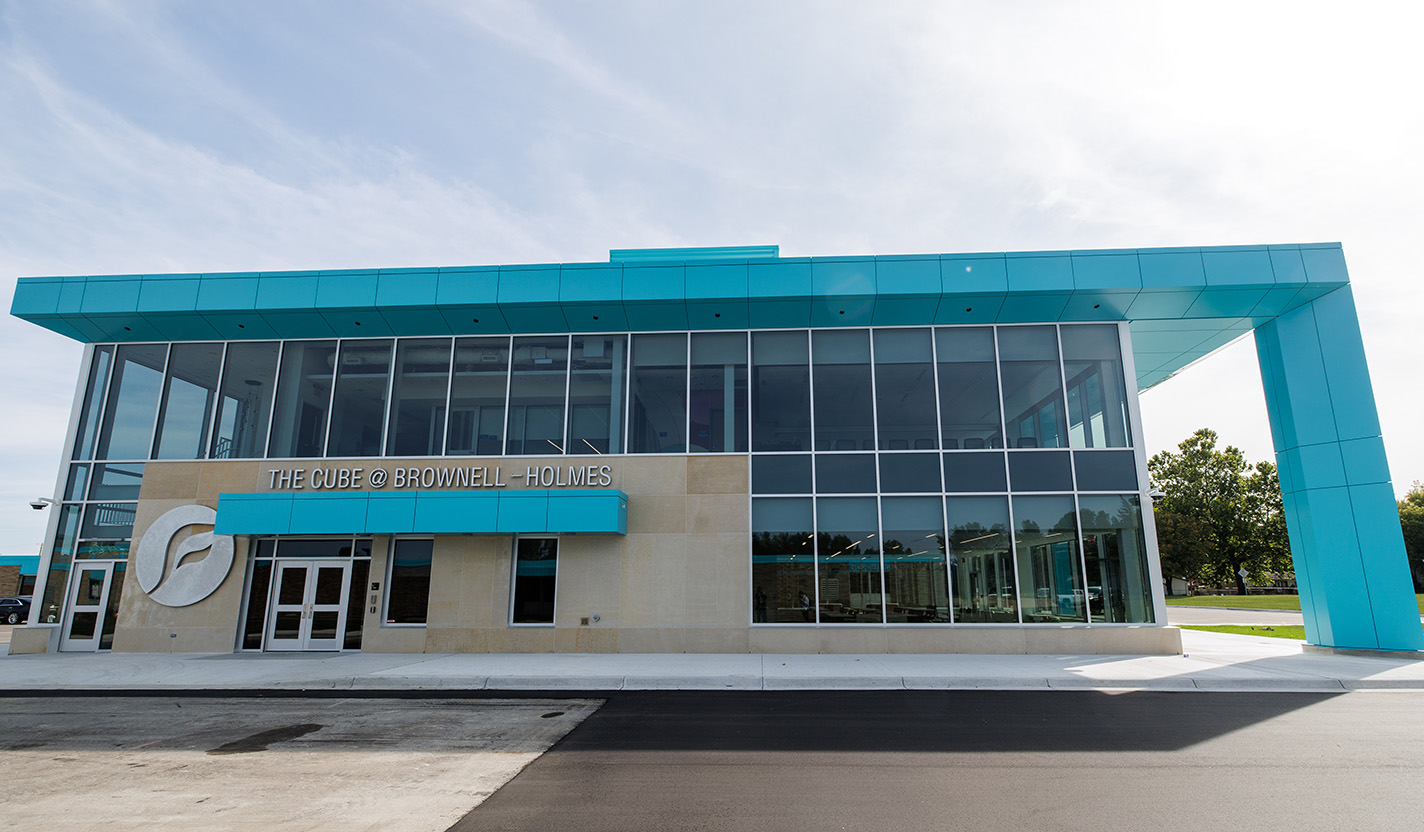
This wholistic approach is demonstrated at The Cube, a 5,000-square-foot building — constructed with Mott support — on the Brownell STEM Academy and Holmes STEM Middle School campus on the city’s north side. Opened in September 2025, The Cube provides an exciting learning environment for students during and after the traditional school day. It also offers a vibrant community space for adult education classes, services for senior citizens, neighborhood meetings and recreational activities for all ages.

As it echoes the creation by C.S. Mott and Frank Manley of a unique model of community schools that was replicated around the world, the Flint Center for Educational Excellence offers people and schools beyond the city an innovative approach to aligning strategic focus, collaboration and commitment to educational excellence.

TBD

The Cube @ Brownell-Holmes is an exciting new addition to the schools’ campus.

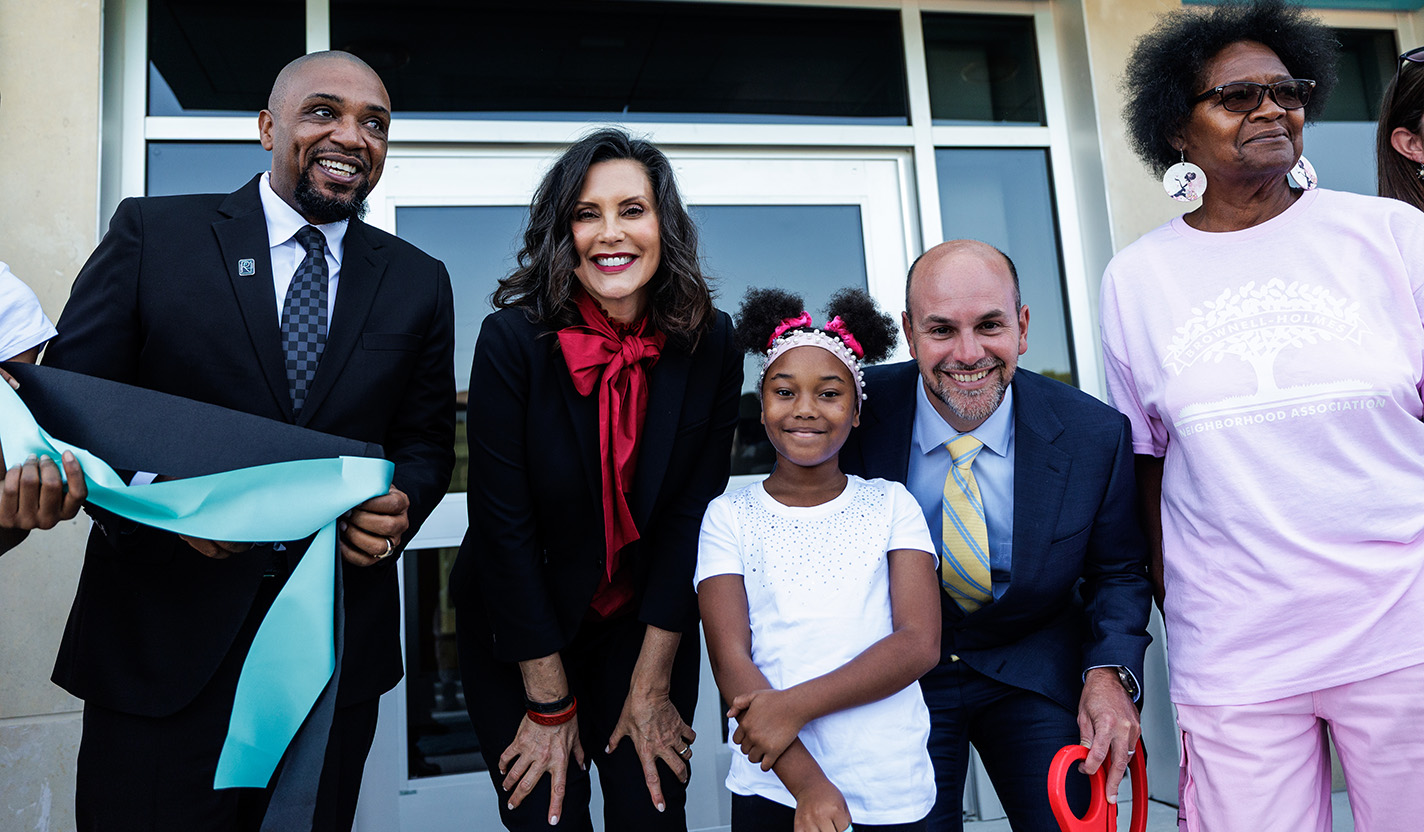
Flint Community Schools Superintendent Kevelin Jones, Gov. Gretchen Whitmer, a Brownell-Holmes student, Mott Foundation President and CEO Ridgway White, and community leader Jeanette Edwards celebrate the opening of The Cube @ Brownell-Holmes.

A large classroom in bright colors and with modern furniture.

Opened in 2025, The Cube offers vibrant, engaging spaces for students and the Flint community.