
Issue
Higher Education
On This Page:

Photo: Charles Stewart Mott Foundation archives

Photo: Rick Smith
Highlights
Between 1959 and 2020, the Mott Foundation granted more than $43 million to support historically Black colleges and universities.
Charles Stewart Mott donated his own land and funds to help create what would eventually become Mott Community College.
The University of Michigan-Flint later would get its start on the same land.
Since 1952, the Mott Foundation has granted more than $46 million to support MCC programming and new buildings.
Since 1958, the Mott Foundation has granted more than $81 million to support UM-Flint through programs, new buildings and other support for students.
Since 1983, the Mott Foundation has granted nearly $90 million to support Kettering’s efforts to provide strong educational opportunities for its students and contribute to the economic revitalization of Flint and the region.
Since 1935, the Mott Foundation has granted more than $74 million to Michigan State University to support building projects, programming and initiatives in Flint.
As far back as 1947, the Mott Foundation supported higher education because C.S. Mott cared deeply about supporting the full educational continuum — from cradle to college and career.
The Foundation’s higher education grantmaking is primarily broken into two buckets — support for historically Black colleges and universities and support for higher education institutions in our hometown of Flint.
Many of the higher education grants in the early days were only $100 or less. They focused on scholarships, endowments, and special projects for colleges and universities in Flint and across the country. However, significant support came by way of donated land and capital funding to build infrastructure that still stands today.
Support for HBCUs
Recognizing HBCUs as vital to the education of underserved people and to the preparation of Black leaders nationally and globally, the Mott Foundation began making grants in 1959 to strengthen those institutions. The Foundation made a small initial grant that year to the United Negro College Fund and amplified its commitment nearly 20 years later, in 1978, with a $1 million grant to the Fund.
Other early support in the 1960s included funding for scholarships at Howard University. The Foundation also supported programs that benefited all HBCUs through grants to organizations such as the Southern Education Foundation, which promotes educational opportunities by addressing racial and economic inequalities.

Keith L. Mcrae and fellow students at Fort Valley State College — 1979.
Photo: Charles Stewart Mott Foundation Archives
Photo: Charles Stewart Mott Foundation Archives
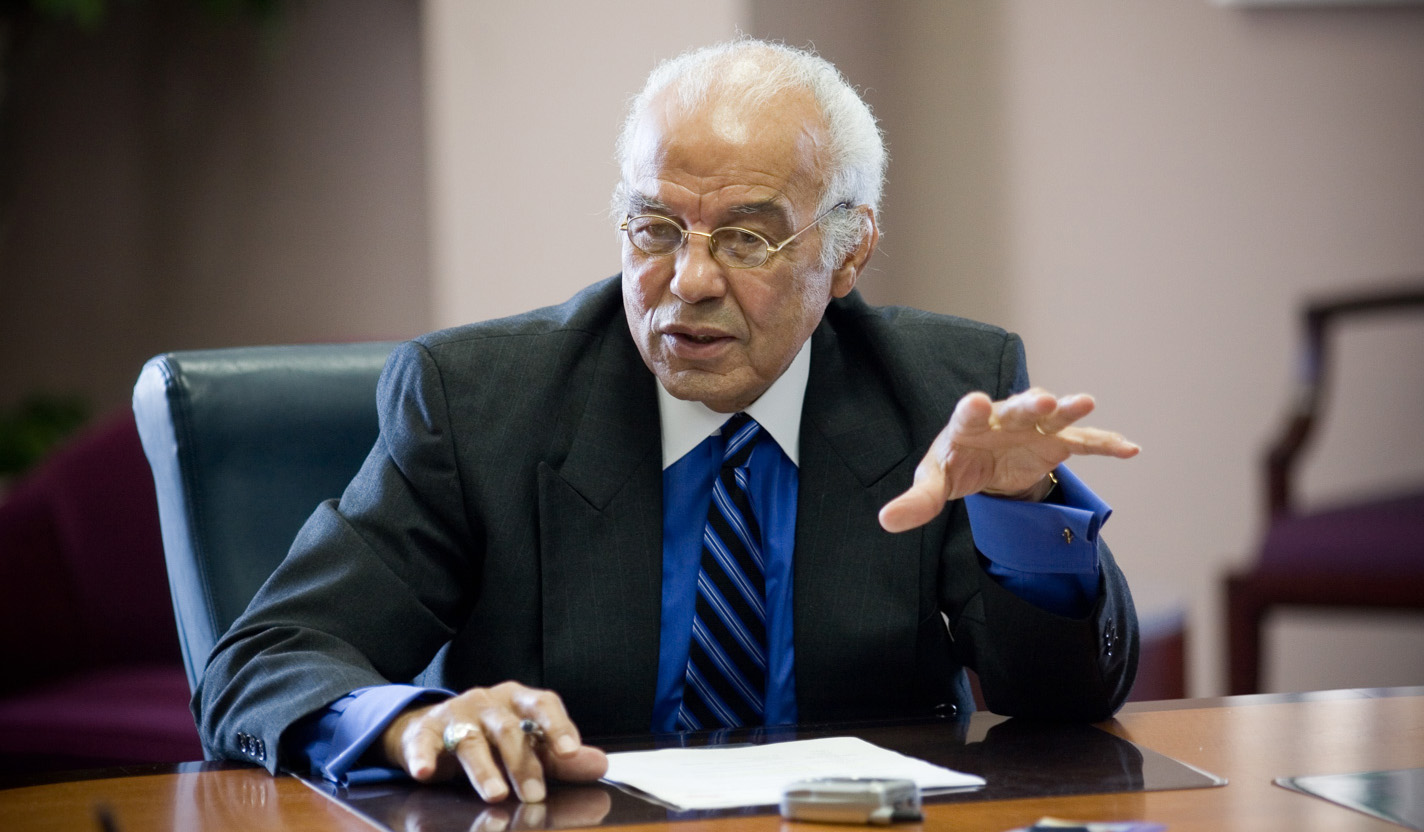
Past President of Xavier University of Louisiana, Dr. Norman C. Francis.
Photo: Rick Smith
Photo: Rick Smith

Students gather on the steps of a Xavier University of Louisiana building.
Photo: Rick Smith
Photo: Rick Smith

Xavier University of Louisiana students, left to right — Canieta Creighton, Shameka Darison, Donald Brown and Breyanna Grays — stand in front of the university's coat of arms in 2007.
Photo: Rick Smith
Photo: Rick Smith

Xavier University of Louisiana student Caneita Creighton attends a lecture along with other students in 2007.
Photo: Rick Smith
Photo: Rick Smith
Support for historically Black colleges and universities
1/5
The Foundation believed, and still believes, that HBCUs are critically important for providing not only a great education, but also culturally supportive and welcoming environments for Black students. Through 2020, the Mott Foundation granted more than $43 million in support of HBCUs.
Examples include:
- $650,000 between 1999 and 2002 to the Clemson University Research Foundation to support Call Me MISTER, a program aimed to recruit, train, certify and place Black men as elementary school teachers in South Carolina.
- $200,000 in 2005 to the Phelps Stokes Fund to develop a national Call Me MISTER program.
- $1.2 million to the Southern Education Foundation in 2003 to support research and development activities in response to the accreditation crisis facing many HBCUs at the time.
- $1 million to the Southern Education Foundation in 2005 to support Hurricane Katrina relief for Dillard University and Xavier University in Louisiana.
- An additional $500,000 in 2006 to Xavier University to rebuild laboratories, classrooms and offices.
- $150,000 in 2020 to Clark Atlanta University to help develop its Executive Leadership Institute program, which aims to prepare and support future presidents of the nation’s HBCUs.
Support for colleges and universities in Flint
The bulk of the Foundation’s higher education support focuses on colleges and universities in our hometown of Flint. Since 1967, the Mott Foundation has granted over $288 million to support the University of Michigan-Flint, Mott Community College, Kettering University and Michigan State University.
Programs and initiatives integrated throughout each school also have helped support students and their diverse needs and created opportunities for them to meet the goals they envisioned for their future. The colleges and universities also add to the vibrancy of the city, with construction of new buildings, renovations of older structures and the creation of community on each of the campuses.
Below is a breakdown of Mott Foundation’s support for Flint-based colleges and universities:
Mott Community College
In 1923, the Flint Board of Education established Flint Junior College, later to be renamed Mott Community College, to make a college education available to Genesee County students locally and at minimal cost.
In 1951, C.S. Mott donated 32 acres of his own farmland and additional funds to build a new campus. In 1952, the Mott Foundation made its first grant to support the purchase of more land. In 1959, the Mott Foundation granted $1 million for the construction of a library for Flint Junior College and UM-Flint, which shared the campus.
I used to look out my window and see six cows. Now I look out and see 6,000 students. I think I made a pretty good exchange.”![]()
Charles Stewart Mott
In 1969, Genesee County residents voted to convert Flint Junior College into a countywide college called Genesee Community College. When C.S. Mott died in 1973, the school was renamed Charles Stewart Mott Community College in recognition of its longtime champion.
Since 1952, the Mott Foundation has granted more than $46 million to support MCC programming and new buildings, including:
- More than $4.9 million in 1999 to get the site ready for MCC’s new Regional Technology Center.
- $3 million to help MCC create the Lenore Croudy Family Life Center, which opened in 2021 to provide students, staff and their families with access to a food pantry, a clothing closet, an early childhood center and other resources.
- More than $2.7 million between 2017 and 2025 to support MCC’s Adult Career Pathway Program.
- $12.5 million in 2021 to update and renovate the Marie Prahl College Center.
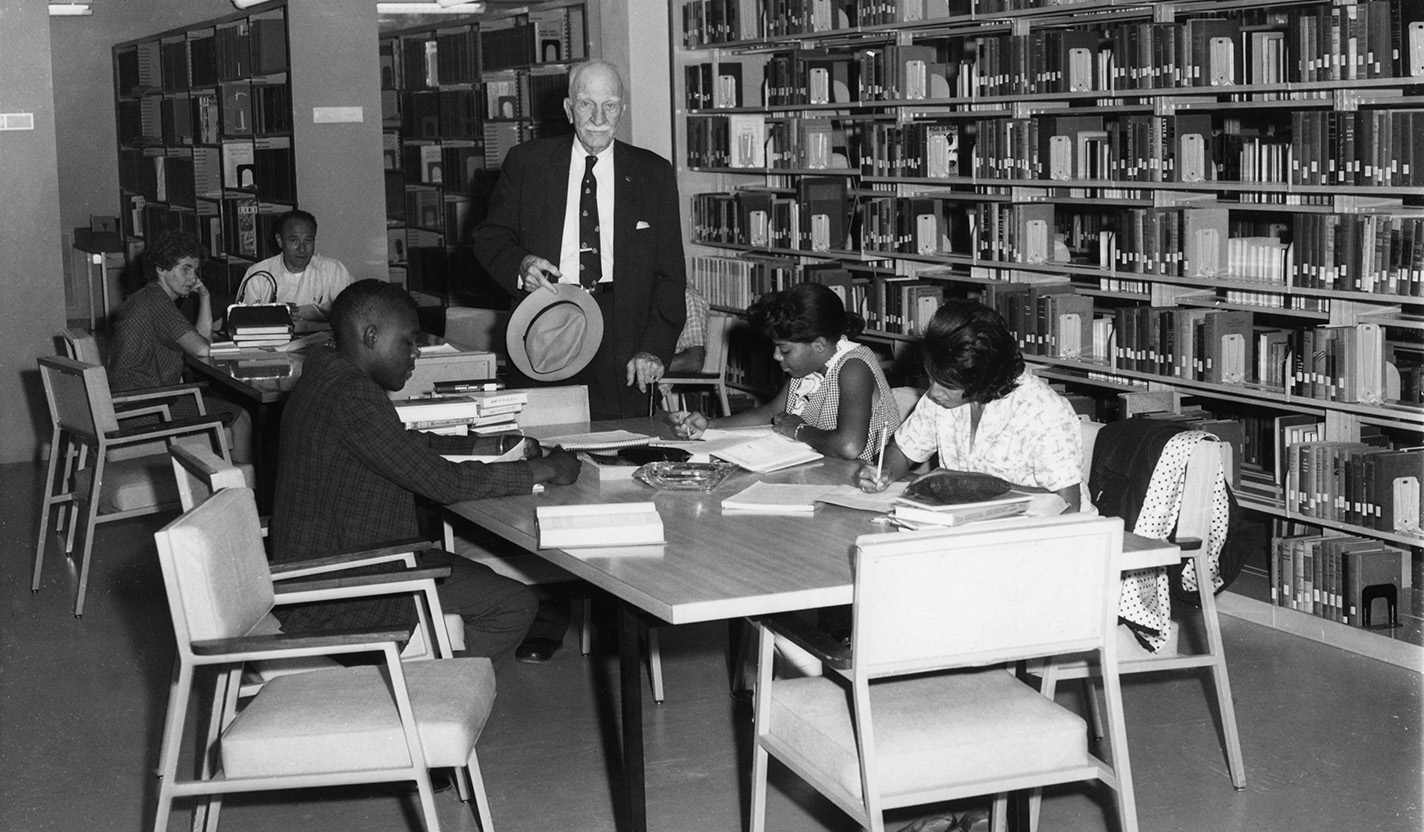
C.S. Mott visits with students in the library at Mott Community College.
Photo: Charles Stewart Mott Foundation archives
Photo: Charles Stewart Mott Foundation archives

A Mott Community College student uses equipment in the MCC Regional Technology Center.
Photo: Rick Smith
Photo: Rick Smith

Ridgway White, president and CEO of the Mott Foundation, tours Ellen’s Closet in the newly opened Lenore Croudy Family Life Center at Mott Community College.
Photo: Cristina Wright
Photo: Cristina Wright
Mott Community College over the years
1/3
University of Michigan-Flint
The Mott Foundation has supported UM-Flint from its inception. C.S. Mott and Harding Mott personally led the charge to establish the college through the Flint Board of Education. Additionally, C.S. Mott provided initial funding for the four-year college and a library. Harding Mott and Bill White were both personally instrumental in UM-Flint’s development, and prominent buildings on campus bear their names.
As early as the 1940s, Flint leaders began discussing the possibility of bringing a University of Michigan institution to Flint, stating that Flint was the only major urban city in the state without a four-year college. In the 1950s, that vision started to become a reality.
In 1955, C.S. Mott donated $1 million of his own funds to help build the Mott Memorial Building on MCC’s campus. And in September of 1956, 167 students began their first day at Flint Senior College, which was later named University of Michigan-Flint. The Mott Foundation’s first grant to support UM-Flint was in 1958 to help purchase furniture and equipment for the Mott Memorial Building.
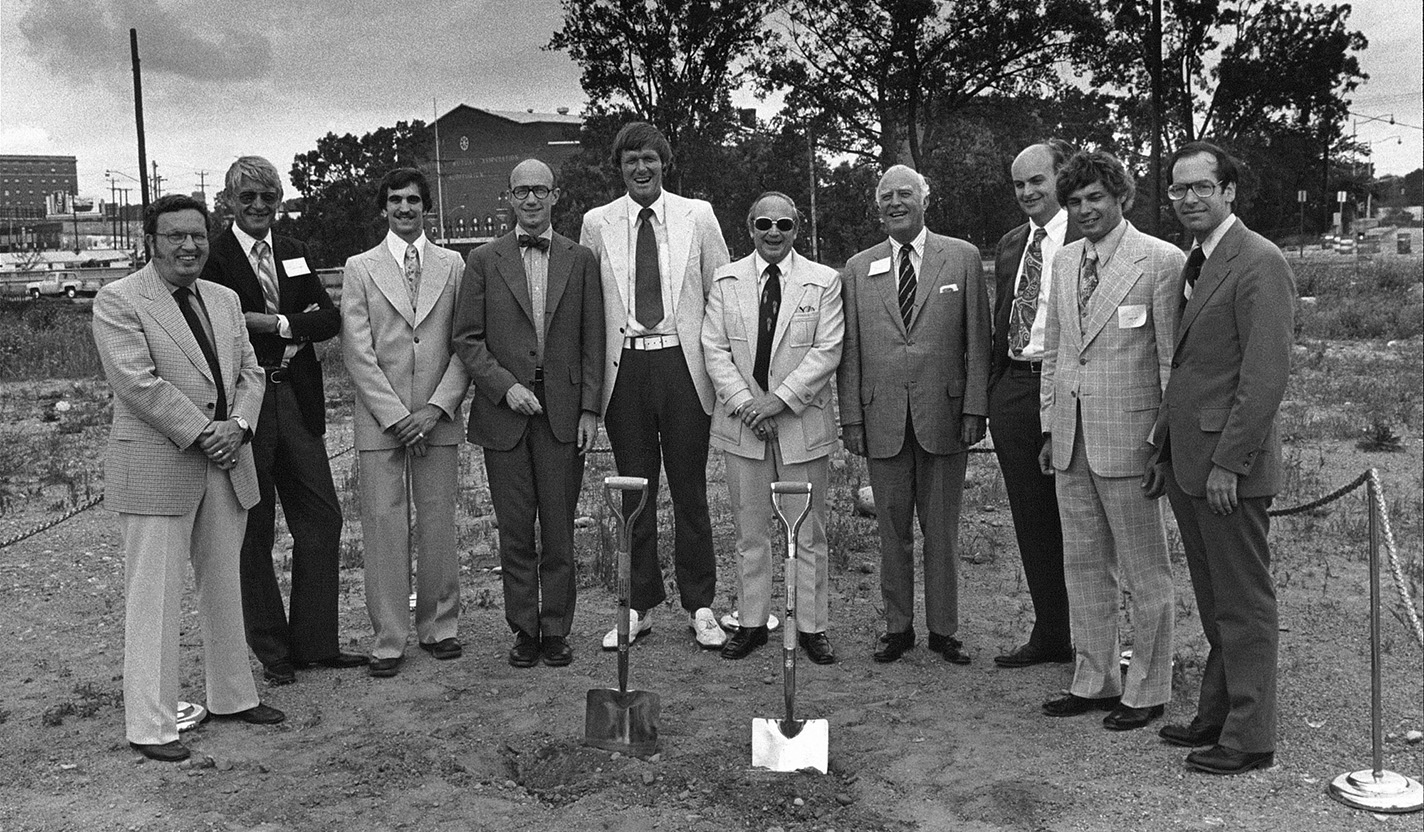
Bill White (third from the right) and Harding Mott (fourth from the right) attend the groundbreaking for the Harding Mott University Center at the University of Michigan-Flint in 1974.
Photo: Charles Stewart Mott Foundation archives
Photo: Charles Stewart Mott Foundation archives
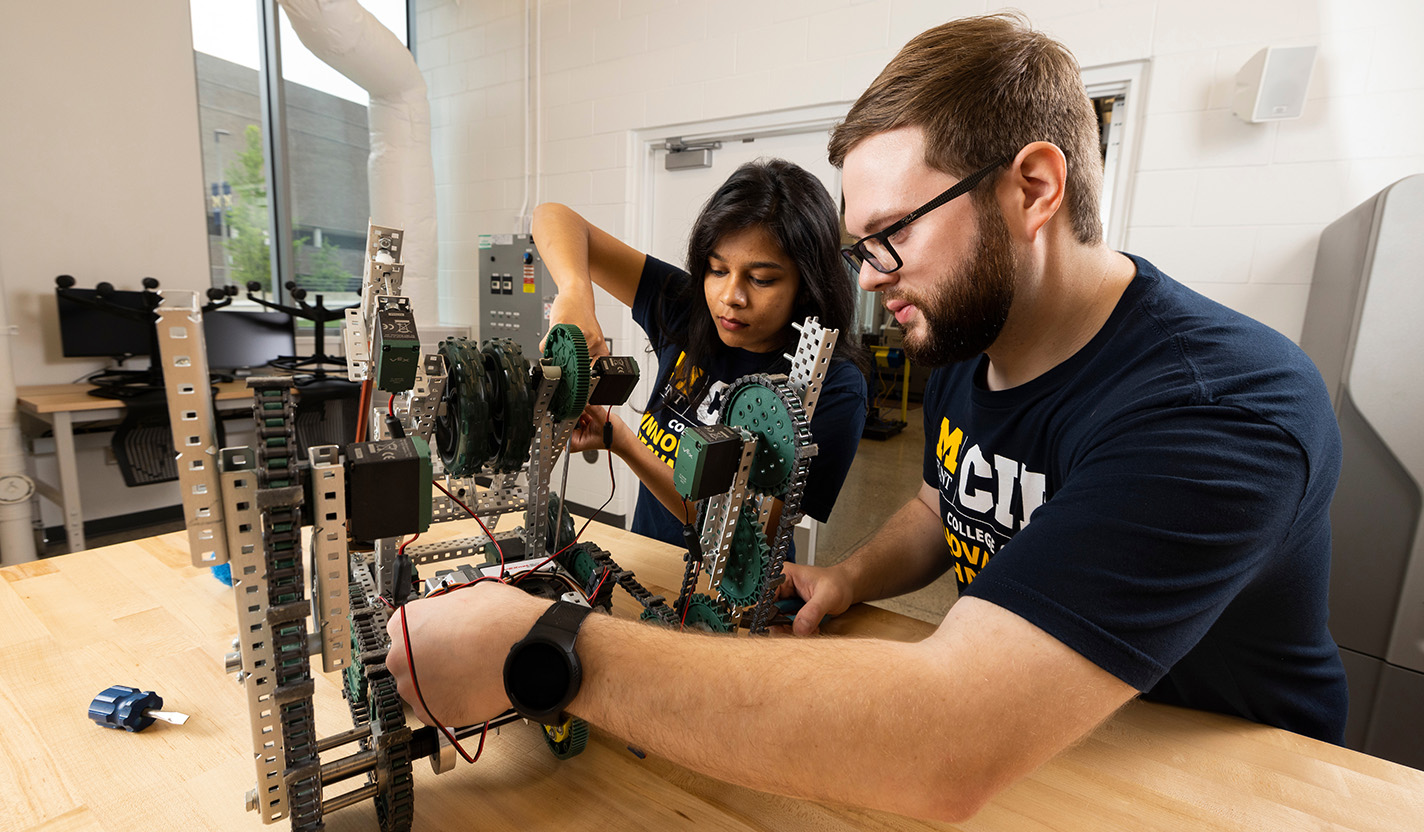
University of Michigan-Flint students enrolled in the College of Innovation and Technology collaborate on a robotics project.
Photo: Scott R. Galvin
Photo: Scott R. Galvin

University of Michigan-Flint students gather on the grass in the middle of campus.
Photo: Cristina Wright
Photo: Cristina Wright
University of Michigan-Flint over the years
1/3
The Foundation intensified its focus on higher education as a key part of its hometown grantmaking with the announcement in 1972 of $5 million to help relocate UM-Flint to the downtown area. The 73-acre riverfront campus now is home to approximately 7,000 students.
Since 1958, the Mott Foundation has granted more than $81 million to support UM-Flint through programs, new buildings and other support for students. Examples include:
- $6 million in 1978 to build a physical education building.
- $2.4 million in 1988 for a campus library.
- $8.2 million between 1994 and 1999 to acquire property and construct new buildings to expand UM-Flint’s campus to the north side of the Flint River.
- $11 million in 2016 to support the expansion of the Murchie Science building and STEM programming.
- A total of $12.2 million in 2020 and 2021 for new construction and programmatic offerings for UM-Flint’s College of Innovation and Technology.
- $475,000 between 2020 and 2025 to support the expansion of Zillion Solutions, which provides opportunities for high school and college students to engage in entrepreneurial learning experiences.
Kettering University
The only fully cooperative engineering and management university in the United States, Kettering University has been an integral component of Flint’s higher education system since 1919, when it was known as the School of Automobile Trades. It was renamed Flint Institute of Technology in 1923.
The Mott Foundation has supported Kettering University from its inception, beginning with internal advocacy from C.S. Mott in his General Motors leadership roles. General Motors acquired the Flint Institute of Technology and transformed it into General Motors Institute, which eventually became Kettering University.

C.S. Mott (standing, left) and Harding Mott (right) visit Flint’s Atwood Stadium in 1968.
Photo: Charles Stewart Mott Foundation archives
Photo: Charles Stewart Mott Foundation archives

Kettering University students work together in a conference room inside the Learning Commons building.
Photo: Cristina Wright
Photo: Cristina Wright
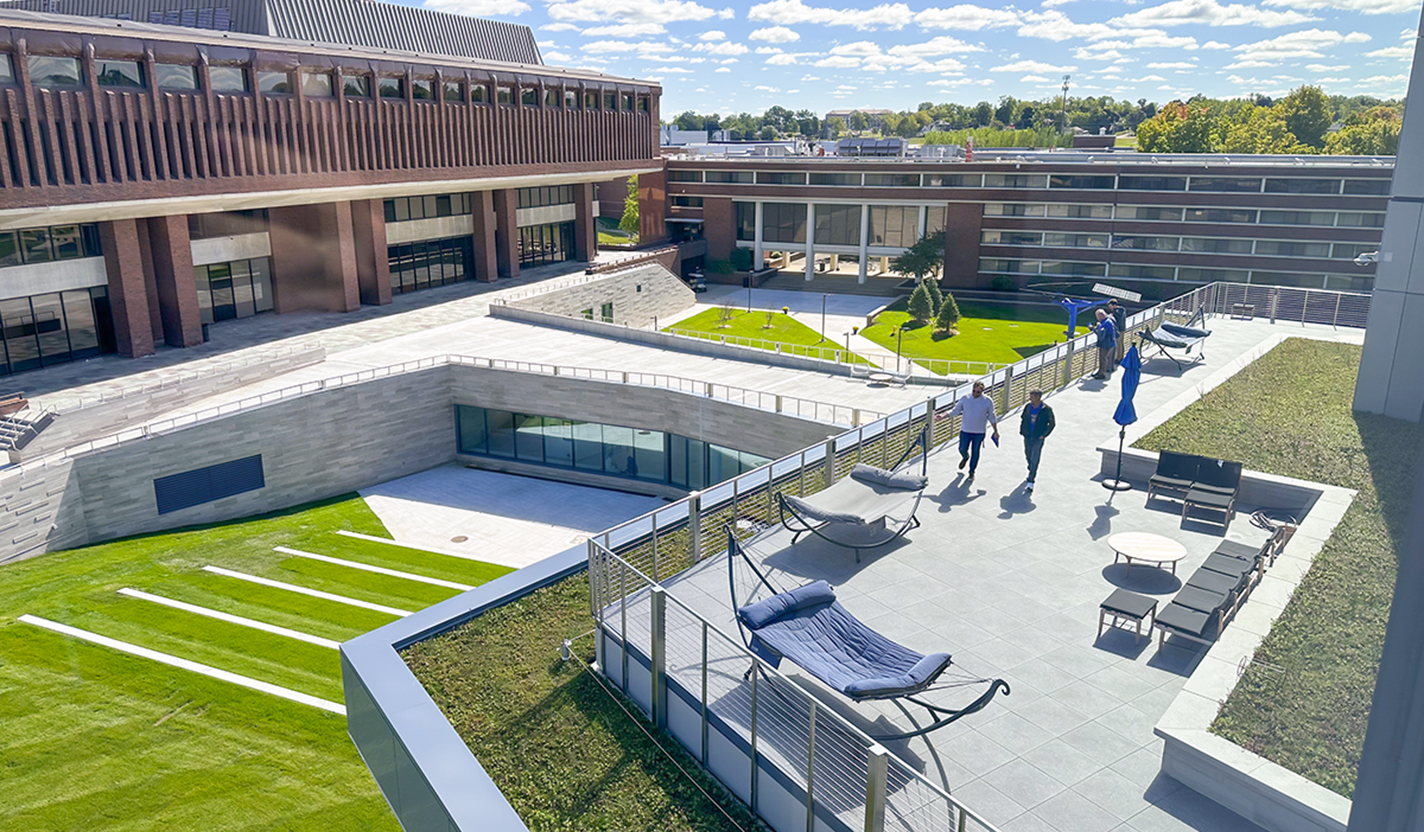
Kettering University students and staff walk on the Learning Commons terrace space.
Photo: Cristina Wright
Photo: Cristina Wright

Kettering University students attend class in 1983.
Photo: Charles Stewart Mott Foundation archives
Photo: Charles Stewart Mott Foundation archives

A Kettering University student solves math problems on a whiteboard in a Learning Commons study area.
Photo: Cristina Wright
Photo: Cristina Wright
Kettering Univesity over the years
1/5
Since 1983, the Mott Foundation has granted nearly $90 million to support the institution’s efforts to provide strong educational opportunities for its students and contribute to the economic revitalization of Flint and the region. Support has included:
- $2 million in 1988 for an endowment for minority student scholarships.
- $7 million in 2000 to support the renovation of a mechanical engineering and chemistry center in the former GM/Delphi building. The C.S. Mott Engineering and Science Center opened in 2003 following renovations.
- A total of $25 million to support the construction of Kettering’s Learning Commons, which opened in the fall of 2022.
Michigan State University
Since 1935, the Mott Foundation has granted more than $74 million to Michigan State University to support building projects, programming and initiatives.
In recent years, the Foundation’s support has focused on MSU’s partnership with Flint residents and strengthening the MSU College of Human Medicine’s presence within the community. The Mott Foundation’s first related grant to MSU was more than $2.8 million in 2011 for planning and a feasibility study, which marked the shift to our current strategy of supporting MSU to expand medical student slots, build community-based public health research and create a Master of Public Health program — all in Flint.

Mother Sandra S. Jones, a Flint community partner in MSU’s public health work, talks with Todd Lucas, Ph.D., a C.S. Mott Endowed Professor of Public Health in MSU’s College of Human Medicine.
Photo: Courtesy of Michigan State University
Photo: Courtesy of Michigan State University

A Flint mom and baby walk in the Rx Kids baby parade, which highlighted the first-of-its-kind citywide cash prescription program for pregnant moms and babies in Flint.
Photo: Jenifer Veloso
Photo: Jenifer Veloso

MSU staff have a meeting in a community space within the new College of Human Medicine expansion in Flint.
Photo: Josh Kennedy
Photo: Josh Kennedy
Suport for Michigan State University School of Public Health
1/3
Subsequent grants have included:
- $12 million between 2011 and 2013 to MSU for the college’s expansion and relocation of its public health program from East Lansing to Flint, as well as $7.7 million to the Foundation for the Uptown Reinvestment Corporation to support renovation of the former Flint Journal building to house the program.
- $25 million in 2021 to expand the MSU College of Human Medicine’s public health presence in Flint. The grant created an endowed fund to increase public health faculty, academic research and community health collaborations.
- $16.75 million to the Foundation for the Uptown Reinvestment Corporation between 2021 and 2023 to expand MSU’s building in downtown Flint.
The Mott Foundation’s support for higher education goes far beyond the classroom. Together, these institutions provide diverse programming to serve students no matter where they are in their educational journey, while also helping to strengthen the community. Both goals are important as we look forward to supporting our hometown for the next 100 years.