
Issue
Afterschool
On This Page:

Photo: Courtesy of New City Kids

Photo: Jenifer Veloso
Highlights
Rooted in the “lighted schoolhouse” model in Flint, Mott grantees helped grow the modern afterschool field, which provides access to high-quality learning opportunities for millions of children.
Mott’s historic public-private partnership with the U.S. Department of Education helped expand the bipartisan 21st Century Community Learning Centers program to serve 1.7 million children each year across 11,000 sites.
Mott supports statewide afterschool networks in all 50 states. They inform local, state and federal policies, support the afterschool workforce, elevate program quality and prioritize community-school partnerships.
Today, more than 29 states support local afterschool programs with state funding, collectively providing nearly $6 billion in funding.
Mott helped launch the Afterschool Alliance, the go-to national organization for the field. The Foundation also has supported public awareness campaigns led by the Alliance, which have been instrumental in keeping public and policymaker attention focused on the importance of preserving and growing afterschool and summer programs for all children.
Mott’s leadership and support helped fuel innovation — from the launch of Mizzen by Mott (now the independent nonprofit Mizzen Education, Inc.) to the expansion of STEM opportunities; college and career readiness; and holistic supports for student learning, development and success.
Decades of research, conducted with support from Mott, finds that participation in afterschool and summer programs has positive, lasting impacts from elementary and secondary school through young adulthood. These include better grades, more social confidence, higher educational attainment, healthier lifestyles, fewer arrests and less substance abuse.
From its earliest days, the Mott Foundation has cared about the health, well-being and education of children — and the vital relationship between individuals and their communities. With these values, in 1935, Charles Stewart Mott joined local educator Frank Manley in launching the Flint-based “lighted schoolhouse” model, which would become a beacon for community education around the world and a cornerstone of the modern afterschool field.

For more than 90 years, Mott and its grantees have helped grow this field, from the development of community schools to partnering with the U.S. Department of Education’s 21st Century Community Learning Centers program, establishing statewide afterschool networks in all 50 states and launching key national organizations that inform educational policy and practice.
From 1998 through 2025, the Mott Foundation granted more than $430 million to support afterschool in the U.S., particularly for children from low-income families and in underserved areas.
Today, afterschool programs benefit millions of young people. Woven into the fabric of American communities, they are vital to children’s development. They nourish curiosity, creativity, self-confidence and growth — and are helping to shape the future of learning.
Connecting schools and communities
Jane Quinn shares the story of a visit she hosted at the Children’s Aid Society in New York City, illustrating the impact of the community schools model in low-income communities. Quinn is a social worker and an architect of the community schools movement going back more than 30 years.
Listen to the StoryJane Quinn
Transcript
Steny Hoyer, a member of Congress from the state of Maryland, a long-term member of Congress — guy who’s always been interested in early childhood and education — he asked to come visit one of our Children’s Aid community schools in New York City. And he wrote about this in one of our books. He said he remembers visiting that school and becoming convinced that this is a strategy that the federal government should support. And — I’m trying to remember what year it was — he put $5 million into the, he kind of slipped it into the federal budget, and it became a vehicle for funding community schools. So Children’s Aid was there the day it, I mean I was with him the day it happened, and I will never forget what he said. He said, so we’re in a school in Washington Heights and he said, he was like, “Jane, Jane, Jane, I get this.” He said, “But why is Children’s Aid doing all this work in a middle-class school?” And I said, “What makes you think this is a middle-class school?” And he said, “Well, the kids look great. Look how engaged they are. They’re well-dressed. They’re well-fed.” And I said, “That’s what kids look like in a poor community when you implement the community school strategy.” It was one of the lowest income schools in the entire New York City school district, but it didn’t look like a poor school because we had enriched the environment, right? That’s what enrichment is all about. So we bandy that word about, but we don’t take enough time to define it. So, to me, a school that has all of those supports and services — medical, dental, mental health, social services, afterschool, a family room, a place for parents to meet other parents, a summer enrichment program — all of that is what makes the environment robust and developmentally supportive for children and families, no matter what their income level is.
Founded in the shadow of the Great Depression, the lighted schoolhouse model in Flint became a crucial resource for working families. This model envisioned local schools as vibrant hubs — for recreation, learning and civic engagement — long after the last school bell rang.
The forerunners of today’s afterschool and summer programs, these centers gave parents peace of mind, knowing that their children had safe places to play and learn with the support of caring adults. Beyond enriching activities that supplemented school-day lessons, they strengthened neighborhoods and helped keep young people engaged, connected and learning.
Drawing on lessons learned in Flint, Mott launched its Advancing Afterschool program area to bring lighted schoolhouses to young people nationwide.

Turning the lights on nationwide for children
From its background in community education, Mott recognized the potential of afterschool programs to transform learning opportunities — and sought to expand the availability of programs to kids across the U.S. But until the 1990s, federal support for afterschool was limited.
A pivotal moment came in 1997, when then Foundation President and CEO William White attended a White House conference on early education and met with then U.S. Secretary of Education Richard Riley and his chief education advisor, Terry Peterson. Riley and Peterson approached the Foundation to help create high-quality afterschool programs through what is now the Nita M. Lowey 21st Century Community Learning Centers program. The Foundation provided an initial $2 million grant and committed to provide up to $55 million more. The historic public-private partnership aimed to bring high-quality, affordable afterschool programs to every child who needed them.

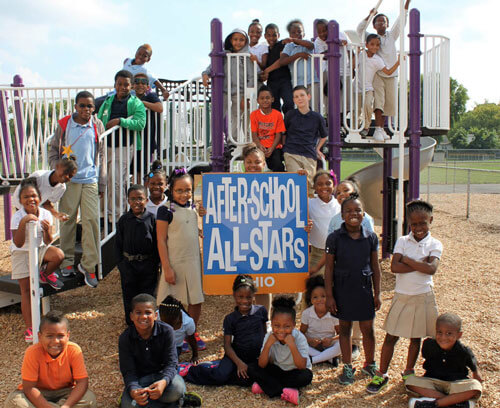
Strategic communications would be an integral part of this effort. To raise awareness about afterschool, the Foundation joined other corporate and philanthropic leaders to develop the “Helping Kids Find the Hero Within” campaign and Lights On Afterschool, a national day of awareness inspired by the enduring symbol of the lighted schoolhouse. Mott helped launch the Afterschool Alliance to lead these efforts. Beginning with 1,200 local events, Lights On Afterschool grew to become a hallmark of the afterschool field. Today’s celebrations attract 1 million Americans to over 8,000 events nationwide, calling on our nation’s leaders to “keep the lights on for kids” everywhere.
Demand for afterschool programs soared. Over just four years (from 2001 to 2004) the nascent bipartisan 21st CCLC program saw a flood of applications that far outpaced program resources. Despite the success of these programs, some in government advocated funding cuts. The Afterschool Alliance and a burgeoning afterschool movement kept public and policymaker attention on protecting these programs for generations of young people.
By 2019, an estimated 1.7 million young people each year participated in 21st CCLC-funded programs at 11,000 sites across the country.
For more than 25 years, Community Learning Centers have accelerated students’ academic growth, engagement and success. Now facing an uncertain future, families, educators and the afterschool movement are stalwart voices for ensuring that future generations of children have access to these essential programs.


Building a field to advance afterschool
As momentum for afterschool grew, Mott helped the field build an infrastructure that could connect out-of-school time leaders and programs, promote effective practices and inform afterschool policies.
Begun in 2002 with networks in nine states — and established in all 50 states by 2015 — the Mott-funded statewide afterschool networks brought together government agencies, nonprofit organizations and individual champions for children to partner in improving educational opportunities for young people. Alongside the networks, Mott funded a group of national technical assistance experts, known as the Afterschool Technical Assistance Collaborative, to help networks with data collection, communications and convenings.

The 50 State Afterschool Network, with support from ATAC, came to serve as a backbone of infrastructure for afterschool education. The “network effect” led to the widespread development of quality programs that prioritize school-community partnerships and project-based learning opportunities in career-related topics such as science, technology, engineering and math, or STEM.
Over the next decade, afterschool opportunities grew substantially.
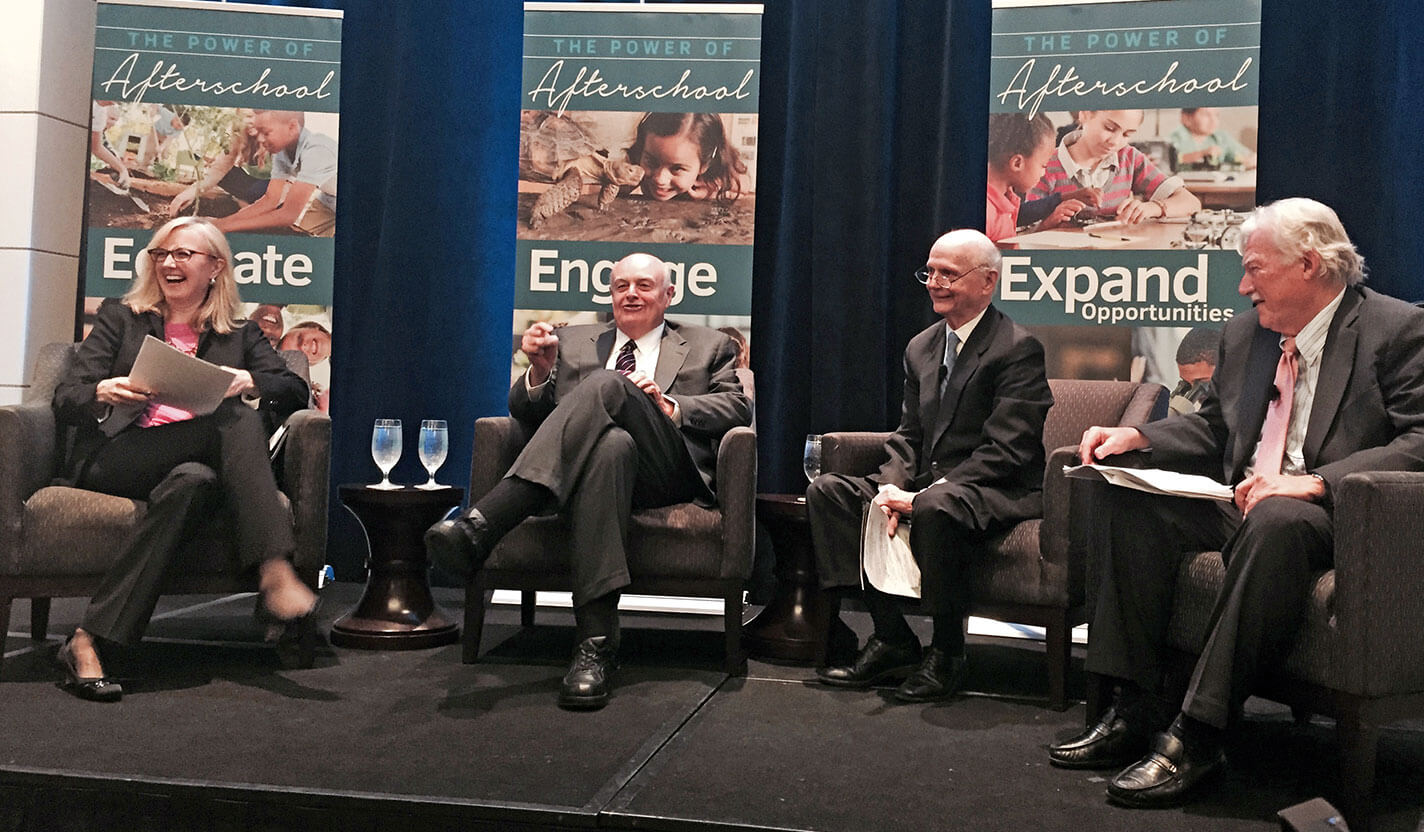
(From left to right) At a 2016 afterschool meeting, Mott Foundation Program Officer Gwynn Hughes interviewed Foundation CEO William S. White, Gov. Richard Riley and Terry Peterson about their longtime collaboration to support and advance afterschool.
Photo: Collaborative Communications
Photo: Collaborative Communications

Victoria Wegener, manager for the Afterschool Technical Assistance Collaborative, speaks at an event in 2023 for the 50 State Afterschool Network.
Photo: Collaborative Communications
Photo: Collaborative Communications

Terry Peterson speaks to the 50 State Afterschool Network in 2025.
Photo: Collaborative Communications
Photo: Collaborative Communications

Tony Smith speaks with network leads at an event for the 50 State Afterschool Network in 2025.
Photo: Collaborative Communications
Photo: Collaborative Communications

Tracye Strichik, network lead at the Alabama Expanded Learning Alliance, at the 2024 50 State Afterschool Network Leaders Meeting.
Photo: Collaborative Communications
Photo: Collaborative Communications

(From left to right) Terry Peterson; Terri Ferinde, founding partner at Collaborative Communications; and Gov. Richard Riley at an Afterschool Network Meeting in Detroit, Michigan — 2016.
1/6

In 2014, the Afterschool Alliance published America After 3PM, the largest longitudinal survey undertaken on afterschool programs. It found that access to afterschool programs had reached an all-time high: 10.2 million children and youth participated in a program — and parents across the political spectrum overwhelmingly supported public funding for afterschool.
But demand continued to far outpace supply.
Mott grantees doubled down on initiatives that would increase access to high-quality afterschool and summer learning programs. Working with the National Conference of State Legislatures, networks improved data collection for policymakers. With the National League of Cities, they helped elevate the voices of mayors. With the Afterschool Alliance, they led forward-looking campaigns, such as “This is Afterschool,” which shared young people’s stories about how afterschool helped them prepare for college, career and the future.
From 2000 to 2024, state-level funding for afterschool and summer learning programs increased 20-fold. Today, 29 states collectively provide nearly $6 billion in funding for local afterschool programs. This includes an unprecedented $50 million investment in out-of-school time programs in our home state, where the Michigan Afterschool Partnership led the public awareness campaign, All in Michigan: Afterschool for Every Child.
Standing with the nation’s children
Having a strong policy and communications infrastructure in place was crucial during the COVID-19 pandemic. When the pandemic raged and schools closed, afterschool and summer programs provided mainstay support for children and families. Mott grantees drove efforts to deliver meals to families, train educators on remote instruction and inform policymakers about needed regulatory changes to keep 21st CCLC doors open.
When the American Rescue Plan Act of 2021 invested $30 billion in recovery funding for afterschool and summer learning programs, our grantees worked tirelessly to ensure that these resources translated into real opportunities for students in every state.

Kids participate in afterschool activities in Hawaii — 2020.
Photo: Hawaii Afterschool Alliance
Photo: Hawaii Afterschool Alliance

Afterschool provides time for children to connect and learn with peers.
Photo: Hawaii Afterschool Alliance
Photo: Hawaii Afterschool Alliance

Kids connect with peers during afterschool activities at the Flint Cultural Academy Center — 2021.

Afterschool programs use STEM activities to engage students.

Kids learn in hybrid environments during out-of-school time at the International Academy of Flint — 2021.

Afterschool programs helped kids stay safe and connected during the height of the COVID-19 pandemic.
1/6
The Foundation intensified support to grantees leading student recovery efforts, contributing $1 million in mini-grants, $500,000 to the Afterschool Opportunity Fund and $300,000 to the Association of American School Administrators. Mott also supported a coordinated effort to help schools and other providers take part in the federal Engage Every Student Initiative and supported the public-private National Partnership for Student Success to significantly expand access to high-quality tutoring and mentoring.
Patrick Stanton, executive director of the Massachusetts Afterschool Partnership, shares how support from the Mott Foundation helped afterschool programs across his state navigate resources and processes during the pandemic.
In the wake of the pandemic, an estimated 17 million students have a learning delay of more than a year and half, and there is a heightened need for mental health supports. The 50 State Afterschool Network is working to help students recover lost learning, engage with mentors and explore new activities that inspire curiosity, connection and confidence.

Fueling afterschool quality and innovation
Creating high-quality programs has always been a central goal for the afterschool field and movement. To support these efforts, Mott has funded research on the impact of afterschool programs and effective models — and helped out-of-school time educators leverage technology to create engaging learning experiences for all students.
Building on decades of research, Deborah Lowe Vandell recently published results from a 26-year longitudinal study of the impact of afterschool that was supported, in part, by Mott. Vandell’s research found that participation in afterschool has positive impacts for youth not only in elementary and secondary school, but well into young adulthood. Young adults who participated in afterschool are more likely to graduate post-secondary training or college, are more engaged in their communities, and have higher paying jobs. Research by the American Institutes for Research, conducted with support from Mott, finds that high-quality afterschool experiences are correlated with positive social and emotional development and educational outcomes, including literacy.


To build program capacity, the Foundation incubated and launched Mizzen by Mott — the first online application developed by and for out-of-school time educators. The idea for Mizzen was born in 2017, when Mott president and CEO Ridgway White asked, “How can we use technology to help ensure that all kids — no matter where they live and learn — can always have access to outstanding learning opportunities in out-of-school time?”
As intended from the start, Mizzen spun off in October 2023 to become an independent nonprofit, Mizzen Education, Inc. Today, its robust and intuitive platform brings free, turnkey lessons from Nickelodeon, The Nature Conservancy, Jazz at Lincoln Center, PBS Newshour Student Reporting Labs and other content partners to educators and youth around the country.
State networks, with support from Mott, have led efforts to raise quality standards and served as laboratories for learning innovation. Over 40 states have implemented statewide quality standards governing afterschool. New state-funded afterschool programs now include evaluation measures that better track program impact, and significant resources exist to support afterschool credentials for educators. State networks helped launch and introduce Mizzen to the afterschool field. The networks have collaborated with Million Girls Moonshot, an initiative of the STEM Next Opportunity Fund, to make STEM more engaging and available to millions of young people, and they also helped to develop the first-ever statewide afterschool program dedicated to advancing holistic mental health supports for kids.
Preparing youth for their futures
As a field, afterschool is working to prepare young people for emerging jobs and opportunities.


Through service learning, entrepreneurial education, STEM programs, and career and technical education, afterschool programs — now in rural, urban and suburban communities around the country — are helping students pursue their interests and build skills and leadership abilities that put them on a path to success.
The best out-of-school time programs reflect the voices, insights and priorities of young people. Mott grantees are working to ensure that students are at the forefront of program design and national discussions that shape the future of learning.
Isaiah Demetrius McNabb, a senior at Flint Southwestern Classical Academy and member of a Thrive Afterschool e‑sports club, reflects on why afterschool programs matter for students.
Stephan Burns, an 11th-grader and the President of the Teen Advisory Council at Flint Southwestern Classical Academy, explains why afterschool is critical for young people to connect with peers and learn career-ready skills.