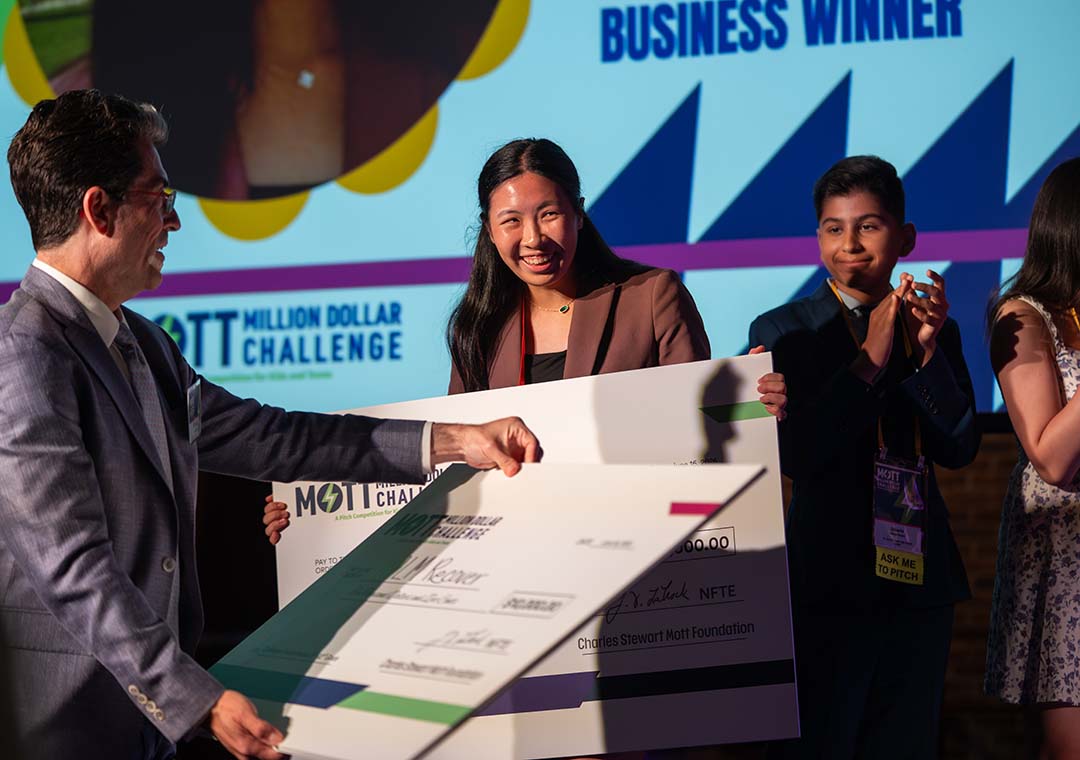
Months after the Mott Million Dollar Challenge concluded, Kayley Xu is still testing her winning solution and thinking about how to bring it to market. The STEM-loving teen pitched a wearable medical device she designed to improve respiratory diagnostics.
“I’m really grateful for experiences like these as they’re really formative for helping young people like me decide what they want to do in the future,” said Xu, a 12th grader from San Diego, California.
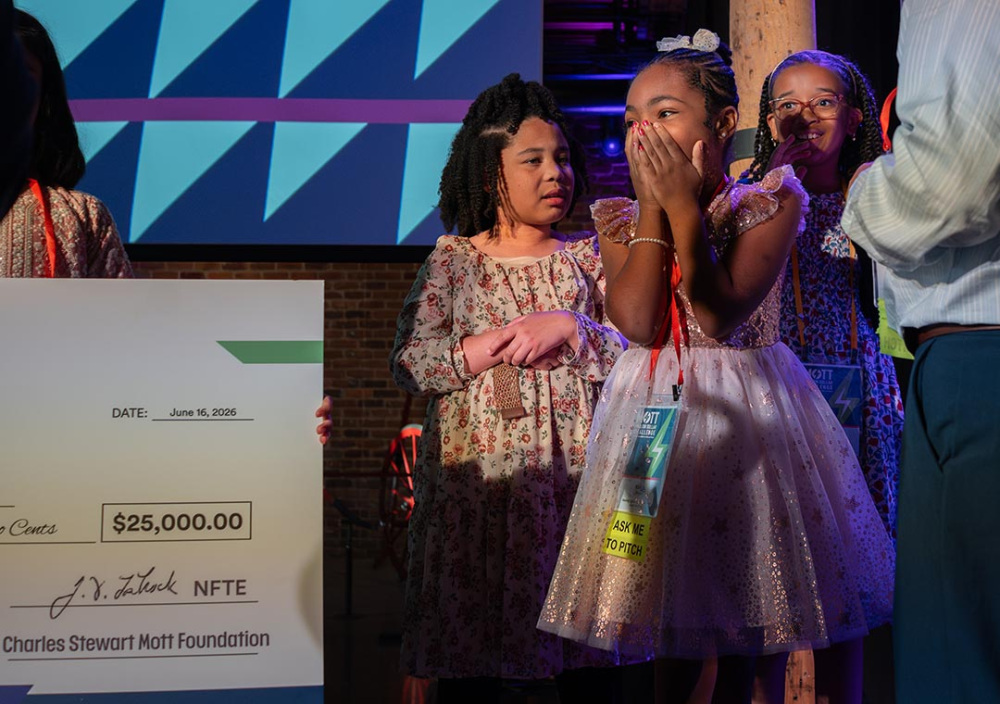
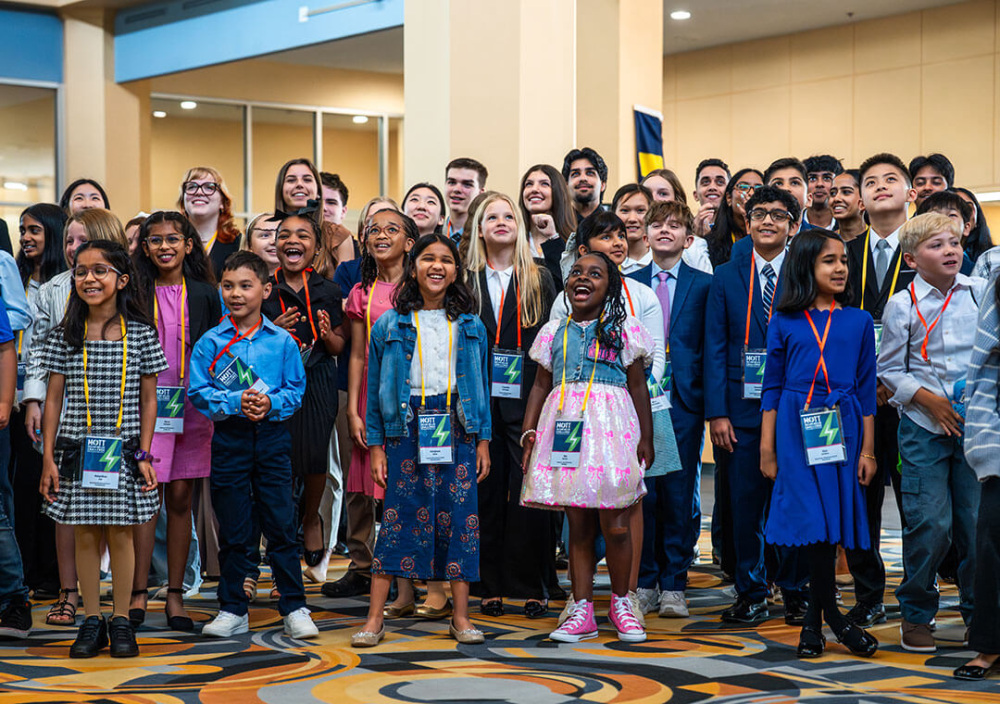
At the outset of the year, thousands of young entrepreneurs across the country submitted pitch videos to the Challenge, a competition for K-12 students. The Challenge was part of the Mott Foundation’s centennial celebration and culminated in June with an in-person pitch competition in Flint.
Xu’s was one of the top six ideas that took home grand prizes of $25,000. As they prepared to head back to school at the end of the summer, we spoke with each of the recipients of the top awards.
Explore the grid below to hear from them about what inspired their winning ideas, what they learned from participating in the competition and how they plan to continue innovating into the future.
Funded by the Charles Stewart Mott Foundation as part of our centennial celebration, the Mott Million Dollar Challenge was administered by the Network for Teaching Entrepreneurship in collaboration with VentureLab, the Young Entrepreneur Institute, the Afterschool Alliance, Collaborative Communications and the 50 State Afterschool Network.
Siya Krishna, a third grader from Parlin, New Jersey, won the grand prize of $25,000 in the K-4 grade social solution category of the Mott Million Dollar Challenge. The following interview has been edited for length and clarity.
Mott: Tell us about your idea and what inspired it.
Krishna: My idea for the Mott Million Dollar Challenge is KindLeaf. It’s a plantable greeting card.
I got the idea after I made a card for my friend who was sick. Later I saw the card in the trash, and that felt sad. Then I thought, “What if a card could keep growing?” With KindLeaf, you write a kind message, and the person can plant the seed paper. Instead of becoming trash, it becomes something beautiful.
Mott: What was it like creating your pitch video?
Krishna: Making my video was exciting because I got to turn an idea into something other people could see.
Mott: What did you do to prepare for the competition in Flint?
Krishna: I had to read the script a thousand times, and then I had to memorize it a lot. I had to present it to my family, my grandparents and like everybody that I know. So, I got the hang of presenting to random people.
Preparing to go to Flint, I learned how to be confident, how to be curious and how to be myself.
Mott: What did it feel like to pitch your idea in front of the judges?
Krishna: At first, I felt really nervous, but then after I explained it a little bit more, I felt way more confident, and it was exciting. It was fun, and I liked presenting.
Mott: In your final pitch, you had to describe a trait of entrepreneurship you’d demonstrated along the way. What did you tell the judges?
Krishna: During this competition, I learned how to be curious and how to solve problems in new ways. Like when I saw regular greeting cards getting thrown away, I turned that problem into a business idea.
Mott: What’s next for KindLeaf?
Krishna: I’m continuing to make my KindLeaf cards. My next step is to actually pilot KindLeaf at my elementary school. It was in the school newsletter for June!
Kailyn Brown, a fourth grader from Columbia, South Carolina, won the grand prize of $25,000 in the K-4 business category of the Mott Million Dollar Challenge. The following interview has been edited for length and clarity.
Mott: Tell us about your idea and what inspired it.
Brown: My idea for Mott Million Dollar Challenge was Sticky Pals with Magic Medicine.
Sticky Pals is a formulated patch that, when applied to the skin, numbs the area where you get a shot. It is mainly for kids, and it is adapted for teens and adults.
And I came up with this idea because I don’t like getting shots personally. So I just wanted to come up with an idea that would help with that.
Mott: What was it like making your pitch video?
Brown: It was kind of exciting and kind of scary. I had to record it four or five times because the first two times I went too fast, and then the second two times I kind of went too slow.
I learned that I shouldn’t get tired of going on and on. I should keep on going and go the extra mile.
Mott: How did you prepare for the in-person competition in Flint?
Brown: My auntie helped me build the pitch and then my mom helped me practice it.
I had five or six pages, and I worked on my pitch every Tuesday and Thursday.
I also worked with Miss Elizabeth from VentureLab. She was really nice, and she helped me a lot. She came up with some suggestions, and she said I did really good with my pitch.
Mott: In your final pitch, you had to describe a trait of entrepreneurship you’d demonstrated along the way. What did you tell the judges?
Brown: I chose growth mindset. I think a growth mindset is important for solving problems because it makes sense to learn more about the problem rather than just seeing it as a stone. Instead of trying to kick it or trying to get rid of it, it would be easier if you could just try to climb it.
Mott: What makes entrepreneurship fun?
Brown: You get to solve problems, and solving problems is fun because you get that big warm feeling inside and then everybody’s like, “Thank you for solving that problem because I have that problem a lot.”
And then you just get happier and happier and happier until you feel like you’re about to burst with happiness!
Mott: What’s next for Sticky Pals?
Brown: I am going to make more characters because teens and tweens could be interested in dinosaurs and unicorns, but I don’t know about adults.
So maybe smiley faces. Maybe rainbows, like the fluffy cloud rainbows. And then shooting stars, maybe.
Siddharth Vikram, an eighth grader from Carlisle, Massachusetts, won the grand prize of $25,000 in the 5-8 grade business idea category of the Mott Million Dollar Challenge. The following interview has been edited for length and clarity.
Mott: Tell us about your idea for the Mott Million Dollar Challenge and what inspired it.
Vikram: My idea for the Mott Million Dollar Challenge was ReHappy. ReHappy is an at-home rehabilitation app that makes rehab fun, engaging and productive by making kids do rehabilitation activities while having fun using games.
A few years ago, my brother was in a car accident. He’s fine now, but during that time, he was at a rehab center, and I really saw the positive effect that the games therapists used had on him. He did it with such vigor that I was definitely convinced that those were the most effective ways to do therapy.
And then when I thought about accessibility, a lot of people can’t go to the in-person centers. They’re doing it at home on their computers. There’s nothing fun. There’s nothing built for children. And I just really wanted to make a solution where children could have fun.
Mott: Who is your target audience and why is learning about them important?
Vikram: My target audience is children who have socioeconomic disadvantages so they can’t go to therapy, but they really want to have it and there’s no options.
Learning about the target audience is very important because it allows you to really immerse yourselves in their thoughts and understand: What are they going to want from my idea? What are they going to want me to tell them to be wanting to purchase my idea?
Mott: What did it feel like when you found out you were coming to the semifinals in Flint?
Vikram: I remember one thing: I was jumping with joy. I got the notification and I just ran down and immediately told my dad, and he was also so happy, and we just started instantly formulating a plan for the next steps forward.
I was like, “Wow! These people actually believe in my idea. They’re giving me a chance to prove its worth.” It was just really amazing for me.
Mott: Was this your first time pitching ReHappy?
Vikram: No, I’ve gone through many pitch competitions for other ideas and for ReHappy itself. I submitted a video for ReHappy to another competition. It didn’t get selected, but it did provide me with valuable insight on how I should craft my video, which really helped me with the Mott Challenge.
Mott: In your final pitch, you had to describe a trait of entrepreneurship you’d demonstrated along the way. What did you tell the judges?
Vikram: I talked about empathy, grit and growth.
At first, I did not really know how to code a full-blown app, but I grew my skill set and realized I could use agentic coding and other tools to figure it out. And the idea of expanding your skill set and growing as an innovator was one of the entrepreneurial mindsets I listed there.
Mott: What’s next for you and ReHappy?
Vikram: ReHappy can definitely go places, and I’m very excited to pursue them. I’ve contacted some people that could really help me work on my idea, give me advice and the help I would need to pursue it. I’m definitely excited for this journey to continue.
Nithya Tammana, a seventh grader from Monroe Township, New Jersey, won the grand prize of $25,000 in the 5-8 grade social solution category of the Mott Million Dollar Challenge. The following interview has been edited for length and clarity.
Mott: Tell me about your idea and what inspired it.
Tammana: I knew that so many people around the world don’t have access to clean water. At the same time, we have access to clean water, and we’re just wasting it simply. So that’s what caught my attention. If we are wasting water and 2.1 billion people around the world don’t even have access to clean water, that’s a big issue. I knew I had to do something about it, so I started Save Drop.
Save Drop addresses three problems with three solutions.
First, restaurants waste water when customers don’t finish the full glasses of water served to them. So, I said, “How about serving half a glass of water?” This way people will get the water they need, but instead of a full glass of water, they’ll just get a half glass and refills, if needed. Today, 22 restaurant locations across 11 states have joined the movement.
Second, recirculation pumps in sinks and showers save water by making sure you get hot water on your body immediately. I started a petition to make recirculation pumps mandatory across every household, and as of now, we have more than 650 signatures.
The third is Biolayer, a four-layer, nature-inspired water filter.
Mott: What was it like to create your pitch video?
Tammana: I had to take the important lines of each problem and each solution and put it in the video. It wasn’t easy because I had so many facts and things I had to share. So that wasn’t easy. It took multiple attempts to bring it down.
Learning to make my video was very useful because if I go speak at an event and I have a big, long, boring speech, that’s going to easily make people bored. But if I have more eye-catching facts and things that make people interested, people will actually get interested and involved.
Mott: In your final pitch, you had to describe a trait of entrepreneurship you’d demonstrated along the way. What did you tell the judges?
Tammana: I said courage because I walked in as an 11-year-old asking restaurant owners face-to-face to serve half a glass of water to every single customer coming in. That was scary because I didn’t want the owners to say no, but at the same time I knew that some would.
I wrote letters to every single governor asking to make recirculation pumps mandatory, which definitely took a lot of inspiration and responsibility and courage to do that.
I also did a TED Talk, and I was the youngest delegate in 70 years to be in the United Nations for the Commission on the Status of Women. It took a lot of courage to speak in front of people and do things that I normally would not do.
Mott: Why is it important for young people to learn about entrepreneurship?
Tammana: For young people to be doing things like this, it’s great because they are changing the world action by action. I’m changing the world from the perspective of saving water. And many other people can be changing the world by addressing sports, litter, pollution and other fascinating issues.
Mott: What’s next for Save Drop?
Tammana: I hope that our Serve Half Glass campaign reaches multiple restaurants and to be specific, one restaurant national chain like Olive Garden or Chili’s.
And I hope Biolayer reaches 100 schools. As of now, I tested biolayer on World Water Day 2026, and five other student co-scientists are independently testing biolayer in five different locations to see if my theory was correct.
Then, I’m going to start where I live in New Jersey, and I want to try to get schools to participate. After, I’m going to slowly move state by state. And if things go well, hopefully worldwide.
Kayley Xu, a 12th grader from San Diego, California, won the grand prize of $25,000 in the business idea category at the Mott Million Dollar Challenge. The following interview has been edited for length and clarity.
Mott: Tell us about your idea and what inspired it.
Xu: My idea for the Mott Million Dollar Challenge was Aucura, a family of wearable stethoscope chest pieces that advances the process of auscultation and respiratory diagnostics.
Auscultation is a process of listening to your body’s sounds. It’s often done using a stethoscope. This process has existed for over 200 years, but the device itself, the traditional stethoscope, has remained relatively the same for those 200 years, which is another part of why I was really motivated to advance this technology.
Mott: How did you develop Aucura?
Xu: The process behind Aucura had many different parts to it, spanning both hardware and software and also testing it in real life. I started it a few months after I recovered from pneumonia.
Initially, I started with only software solutions, but eventually, I found that there was a wall due to the hardware not being as advanced as it could be. So, then I started looking into how to design a more robust chest piece. Later, I looked into beamforming algorithms that use the data from that chest piece to provide actual diagnostic information.
I talked to a bunch of people while creating Aucura. For example, I talked to my pediatric physician about the idea. She was able to look at some of the chest pieces I designed and gave me feedback on them. That validated my idea early on.
Mott: How did you prepare for the live pitch in Flint?
Xu: I started with my own story and stated the problem that Aucura hopes to solve. A challenge I was trying to mitigate was making sure the general public could understand the technical aspects of my project. I wanted to make sure the high-level technical details came through.
One aspect I highlighted was how Aucura and the chest pieces I designed were really low cost. So, while traditional digital stethoscopes on the market cost hundreds of dollars, the flexible printed circuit board I designed can be manufactured in bulk for around one dollar. This would allow it to reach areas where medical clinics might not be funded, since it’s relatively cheaper and would enable wider access to digital stethoscope technologies.
Mott: In your final pitch, you had to describe a trait of entrepreneurship you’d demonstrated along the way. What did you tell the judges?
Xu: I highlighted lots of failures I went through while developing Aucura. It definitely wasn’t a very easy process. I had to go through a lot of iterations with prototypes and had to do a lot of problem-solving.
I also highlighted the resourcefulness that I used while approaching Aucura.
I wanted to test Aucura in real life, and it’s kind of hard to do in vitro tests or tests in live human patients. So instead, I created a model of the human torso using foamed gelatin. I took gelatin powder and water and used one of those electrical mixers that you might usually use while baking. I had to experiment with a bunch of different ratios to make sure that when the foam gelatin had finally solidified that the sound of the speed of sound through it mimicked that of the human torso.
What’s next for you and Aucura?
Xu: I definitely want to go to college and study something in STEM. I’m really passionate about electrical engineering and biomedical engineering right now.
And I definitely want to continue with Aucura and try to prepare to bring it to market.
I really hope that Aucura can be used in rural areas or less-funded areas, where they might not have access to that many resources. The end goal of Aucura is for it to be ubiquitous, like a new standard in auscultation technology.
Co-founders (and cousins) Aditya Herekar and Karan Verma won the grand prize of $25,000 in the 9-12 grade social solution category at the Mott Million Dollar Challenge. Herekar is a 12th grader from Edison, New Jersey, and Verma is a 12th grader from Frisco, Texas.
Mott: Tell us about your idea and what inspired it.
Verma: Naturista is the world’s first zero-waste biodegradable and dissolvable coffee pod that embraces our company’s values of the triple bottom line: planet, people and profit.
It all really started with my brother. He was in a research lab, working on dissolvable prosthetics. Aditya had come over to my house for winter break, and he, my brother and I were talking about how cool this entire dissolvable prosthetics concept was.
Then, Aditya and I were drinking coffee one day — we’re both chronic coffee drinkers just because of how high school goes — and we were talking about plastic coffee pods and the truly negative impact they have on the environment, not to mention the microplastics we’re drinking.
We put the two concepts together: these really cool high-tech dissolvable prosthetics and something that was personal to us, something that we could actually relate to, and that we saw as a problem every single day. That’s how Naturista came to life.
Mott: How did you prepare to pitch in person in Flint?
Herekar: First of all, working with NFTE was amazing. It wasn’t only the people coaching us. It was also the sessions they organized so other competitors could hear our pitch and give us feedback.
I remember another student had a sustainable product. At first, I was a bit unsure. What’s the vibe going to be? Are they going to be competitive and not share any of their ideas? But I was pleasantly surprised because they watched our pitch and gave us feedback. And we actually started sharing our own journeys as entrepreneurs.
So not only did we get lots of ideas from other sustainability entrepreneurs, but we also got to hear their own unique stories and their experiences.
Mott: What did it feel like to win the grand prize?
Herekar: It was very close, first of all. Kudos to everyone else who was competing because, honestly, I couldn’t have predicted that we would be the winner.
But winning meant a lot to me because of all the years of hard work Karan and I have put into this business, not just this competition. It felt really good to just be recognized for what we did.
Mott: What have you learned from being an entrepreneur?
Herekar: I’ve learned that when I look around me, there are so many different things just hidden in sight, things that may look to others as normal. The status quo may look to me or another entrepreneur like an opportunity that can be fixed and improved endlessly.
Verma: Being an entrepreneur to me means that you have this opportunity to impact a lot of people’s lives, as well as change your own life. If we were not entrepreneurs, if we had not gone out of our way to try to create Naturista, we wouldn’t have learned so many of the lessons that developed who we are as people.
Mott: What’s next for the two of you and Naturista?
Herekar: We’re both applying to college. We want to major in business. Finishing up college applications is the priority right now.
I also want to keep this business that we’ve been working on for the past years alive. We’ll be focusing on doing the research for Naturista, making sure that we can come closer to commercialization. We’re currently doing pilot runs in our local community. So, I want to focus on taking small steps and pushing every single day, even if our schedules are busy.
Verma: After this college application season ends, we’ll have a lot of good data from our pilot sales, and we really want to get manufacturing samples going. We’re currently in contact with some manufacturers.
Time is of the essence. If we can really start to pick up our pace and go ahead with the manufacturing samples, continue our sales and get more feedback — which has been invaluable from competitions like these — I think we see a really bright future for Naturista.